After the Storms, Some Southwest Louisiana Properties Enter a Second Disaster: The Paperwork
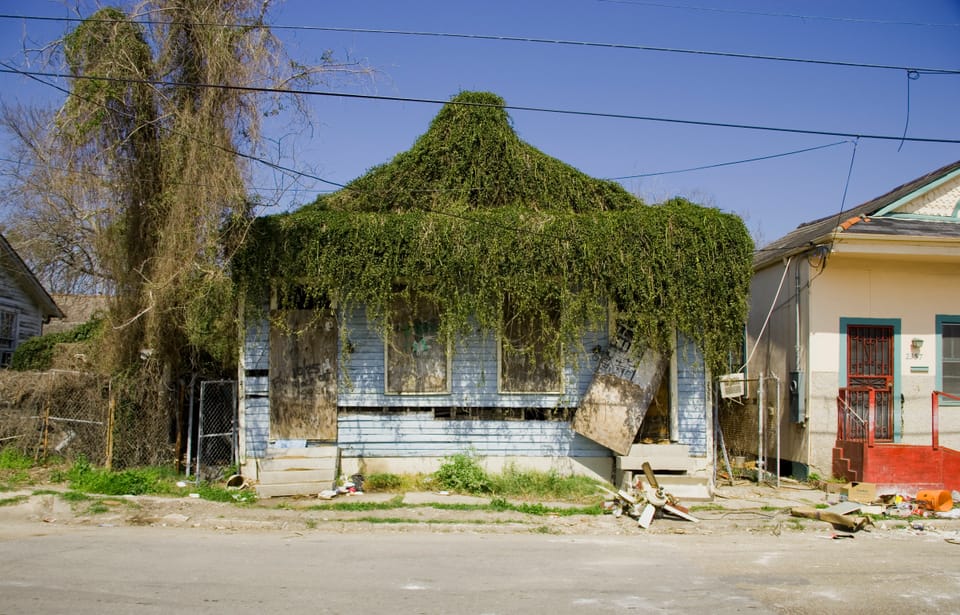
Hurricane Laura made landfall in Southwest Louisiana on August 27, 2020.
Hurricane Delta followed six weeks later.
Homes were damaged. Families relocated. Insurance claims dragged on. Federal recovery programs took years to fully open and distribute money.
Some properties were repaired.
Some were demolished.
Others entered a different kind of recovery process — one governed by tax bills, successions, code enforcement, condemnation hearings and eventually adjudication.
Six years later, Calcasieu Parish is still dealing with that inventory.
The parish's 2025 and 2026 condemnation records include houses, manufactured homes and other structures in Moss Bluff, Lake Charles, DeQuincy, Westlake, Carlyss, Hayes and LeBleu Settlement. Some are still listed in the names of estates, successions or multiple heirs rather than a single current owner.
Separately, Calcasieu Parish continues to sell property that has been adjudicated to the parish because property taxes were not paid and the property was not redeemed.
On September 22, 2026, the parish scheduled another public adjudicated-property auction.
The rules were unusually simple:
No minimum bid.
No appraisal required.
Highest bidder wins.
Those rules do not mean distressed homeowners are being stripped of land overnight.
Adjudication is a legal process with notice and redemption protections.
But taken together with years of storm damage, unresolved estates and delayed recovery, the records raise a larger question:
What happens to family property when the disaster ends long before the paperwork does?
Condemnation and Adjudication Are Not the Same Thing
The distinction is important.
A condemned structure is not automatically a tax-sale property.
Calcasieu Parish Code Enforcement can condemn buildings outside incorporated municipalities when structures are unsafe, unsecured or deteriorated. The parish says the process exists to address public safety, property values and quality-of-life concerns.
Adjudication is different.
The parish defines adjudicated property as property placed into governmental hands after local property taxes were not paid and the property was not redeemed by the debtor.
A property can therefore travel through entirely separate systems.
A storm-damaged home may sit vacant.
The structure deteriorates.
Ownership may remain tied up in an estate.
Taxes remain due.
Code enforcement begins.
At some point, unpaid taxes can create a separate adjudication problem.
None of those steps alone proves displacement.
Together, they create a pipeline through which a piece of family property can become increasingly difficult to recover.
The Ownership Records Already Show the Complications
Look through Calcasieu Parish's condemnation lists and one pattern appears repeatedly.
Not every condemned property has a straightforward individual owner living at the address.
A May 2025 condemnation list included a Moss Bluff property at 1488 Highway 171 owned by the Succession of Elice Lavergne and Virgin Standberry Lavergne.
Another property at 1449 Lavergne Road was listed under the Hillman Lavergne Estate, et al.
A November 2025 condemnation in DeQuincy listed the Paul E. Jones Estate as owner.
Another Lake Charles property was owned by the Eddie Hebert Jr. Family Trust.
Those records do not establish why the structures deteriorated, whether taxes were delinquent or whether any of those properties will ever be sold.
They do show how quickly property ownership becomes complicated when land passes through generations.
Louisiana succession issues can leave several heirs with interests in one parcel.
One heir may live locally.
Another may live in Texas.
Another may not know exactly what they own.
One person may have been paying the taxes for years.
Then a hurricane destroys the house.
The family suddenly has to decide who can file an insurance claim, who has authority to sign contracts, whether the property should be rebuilt and how much money everyone is willing to contribute.
A house can be physically destroyed in one night.
Untangling the ownership can take years.
Disaster Assistance Arrived on a Very Different Timeline
The state's own recovery timeline shows how long the process stretched.
Laura and Delta hit in 2020.
Congress appropriated major Community Development Block Grant disaster-recovery funding in September 2021.
HUD allocated the first $600 million for Laura and Delta in October 2021.
The state did not open the Restore Louisiana homeowner survey until February 2022.
Applications began opening in phases later that year.
The survey deadline for the 2020-2021 disasters did not arrive until August 2023, with the application deadline following in October.
That means some Southwest Louisiana homeowners spent roughly two years between the storms and the opening of the primary state-administered federal recovery program.
During those same years, taxes still came due.
Grass still grew.
Roofs continued leaking.
Vacant structures continued deteriorating.
Successions still had to be completed.
A government recovery program can operate on one timeline while property law operates on another.
Maintaining Ownership Is Itself a Requirement for Assistance
Restore Louisiana requires applicants from the 2020-2021 disasters to have owned and occupied the damaged home at the time of the disaster and to maintain ownership through the program's final project inspection.
The state's voluntary disaster buyout program similarly requires the homeowner to maintain ownership through the buyout process.
That creates an obvious vulnerability.
A homeowner may need disaster assistance because the property was severely damaged.
But remaining eligible for assistance can depend on maintaining control of the property while navigating years of repairs, taxes, insurance, title issues and government paperwork.
Lose the property first, and the recovery program may no longer be able to save it.
Then There Is the Tax-Sale System
Calcasieu Parish's adjudicated-property system exists because property taxes were not paid.
That process is not secret.
The parish publishes an adjudicated-property map, application instructions and upcoming auction information.
Louisiana law also provides notice and redemption protections before ownership interests can be terminated.
Under the law effective in 2026, certain interested parties must receive notice and are given either 60 days or six months, depending on how long it has been since the tax-sale certificate was filed, to redeem the property or challenge the transaction.
Calcasieu Parish also has specific authority under state law to sell adjudicated property after the applicable redemption period.
The September 22 sale illustrates what happens at the end of that process.
The parish announced that parcels adjudicated for unpaid taxes could be offered at public sale.
Interested buyers had to submit an offer and a $75 deposit before the deadline.
If multiple offers were received, qualified bidders could compete verbally.
There was no minimum bid.
There was no appraisal requirement.
The parcel would go to the highest bidder.
That does not mean a bidder simply walks into the Police Jury room and buys someone's occupied house for $75.
The $75 is a deposit associated with making an offer, not the purchase price.
And adjudication follows a legal process before property reaches that stage.
Still, once a parcel reaches the auction stage, its relationship to market value can become unusual.
A property worth tens of thousands of dollars as land does not necessarily have to begin bidding anywhere near that amount.
Where Investors Enter the Picture
Distressed-property investors understand these systems.
Tax sales, adjudicated property, successions and blighted structures require more work than buying a conventional listing.
That work can also create the discount.
A parcel may have title problems.
There may be demolition costs.
The house may be unusable.
Several heirs may have competing interests.
There may be years of taxes, legal notices and administrative records to research.
For an ordinary family, those complications can make the property feel impossible to deal with.
For an investor experienced in distressed real estate, they can represent an acquisition strategy.
The investor does not need the house.
The investor may only need the land underneath it.
That becomes particularly significant in areas where land values recover faster than damaged structures.
A hurricane-damaged home might be economically worthless.
The lot may not be.
The Question Is Who Is Buying
Calcasieu Parish's auction system provides enough information to begin answering that.
Each adjudicated parcel has an assessment number that can be cross-referenced with assessor records.
Auction records can identify successful buyers.
Conveyance records can show what happened afterward.
Secretary of State filings can identify the people behind LLC purchasers.
Multiple auctions can then be compared to determine whether the same buyers repeatedly appear.
That is the next layer of this investigation.
The question is no longer simply how many properties Calcasieu Parish has adjudicated.
It is:
Who ultimately acquires them?
Are neighboring homeowners buying vacant lots?
Are family members recovering inherited property?
Are small local investors purchasing individual parcels?
Or are a relatively small number of companies accumulating distressed property across storm-damaged neighborhoods?
Those are questions the public records can answer.
A $5,000 Tax Problem Can Sit on Top of Much More Valuable Land
Property taxes are based on assessed value, not necessarily the full economic value of a parcel.
That creates an asymmetry in distressed-property situations.
The amount required to trigger years of tax delinquency can be dramatically smaller than the underlying value of the real estate.
A family can therefore lose control of an asset worth far more than the original unpaid tax obligation.
That is not unique to Louisiana.
It is the nature of property-tax enforcement.
The public entity needs a mechanism to collect taxes and return abandoned property to productive use.
Otherwise parcels can remain in legal limbo indefinitely.
But that same mechanism becomes much more complicated after a catastrophe.
A person who simply refuses to pay property taxes is one situation.
A deceased homeowner whose children never opened a succession is another.
A retired homeowner waiting for disaster assistance while living somewhere else is another.
A family that received an insurance settlement insufficient to rebuild is another.
A homeowner who walked away entirely is another.
On a government spreadsheet, several of those properties can eventually look the same.
Delinquent.
Blight Has a Cost Too
There is another side of this issue.
Leaving severely damaged property untouched indefinitely is not a neutral policy.
Abandoned structures attract dumping.
They can become fire hazards.
They lower neighboring property values.
They can harbor animals and create public-health problems.
Neighbors who repaired their homes after the storms have their own legitimate interest in seeing dangerous structures removed.
Calcasieu Parish explicitly identifies health, safety, property values and quality of life as reasons for enforcing its property-maintenance and condemnation ordinances.
The parish cannot realistically leave every damaged building standing forever because ownership is complicated.
Likewise, local governments depend on property taxes to operate.
Allowing delinquent taxes to remain unresolved indefinitely shifts part of that burden onto everyone who continues paying.
The issue is not whether enforcement should exist.
It is what the enforcement system produces after a disaster severe enough to fracture both buildings and ownership records.
Six Years After Laura, the Property Records Are Still Telling the Story
Hurricane recovery is usually measured in rebuilt roofs, FEMA dollars and reopened businesses.
There is another measurement buried in the property records.
Condemnations.
Adjudications.
Estates.
Successions.
Tax sales.
Vacant lots.
New owners.
Calcasieu Parish's records show that damaged and distressed properties are still moving through these systems six years after Laura and Delta.
Some will remain with the same families.
Some will be repaired.
Some structures will be demolished while the land remains with the owner.
Some adjudicated properties will be redeemed.
Others will eventually belong to someone else.
The September 22 auction is only one point in that process.
The next step is tracing those parcels backward and forward — who owned them before the storms, how much tax debt accumulated, who purchased them, what they paid and what happened to the land afterward.
Because the final chapter of hurricane recovery is not always rebuilding.
Sometimes it is a deed recorded under a different name.
Dalton Barron covers real estate, infrastructure, development, public records and the underlying numbers shaping Southwest Louisiana for 337.NEWS.
Barron is also a licensed Louisiana real estate agent with NextHome Bayou Pines, 416 N. Pine St., DeRidder, Louisiana. Jeremy Jones, Broker/Owner.
C. 337.764.1754
O. 337.202.1018
Licensed by the LREC.
Each office is independently owned and operated.
About 337.NEWS
337.NEWS is an independent Southwest Louisiana publication examining real estate, development, infrastructure, public records, business and the numbers behind the region's biggest stories.

Member discussion