Zillow Has No MLS Borders. Why Does Louisiana?
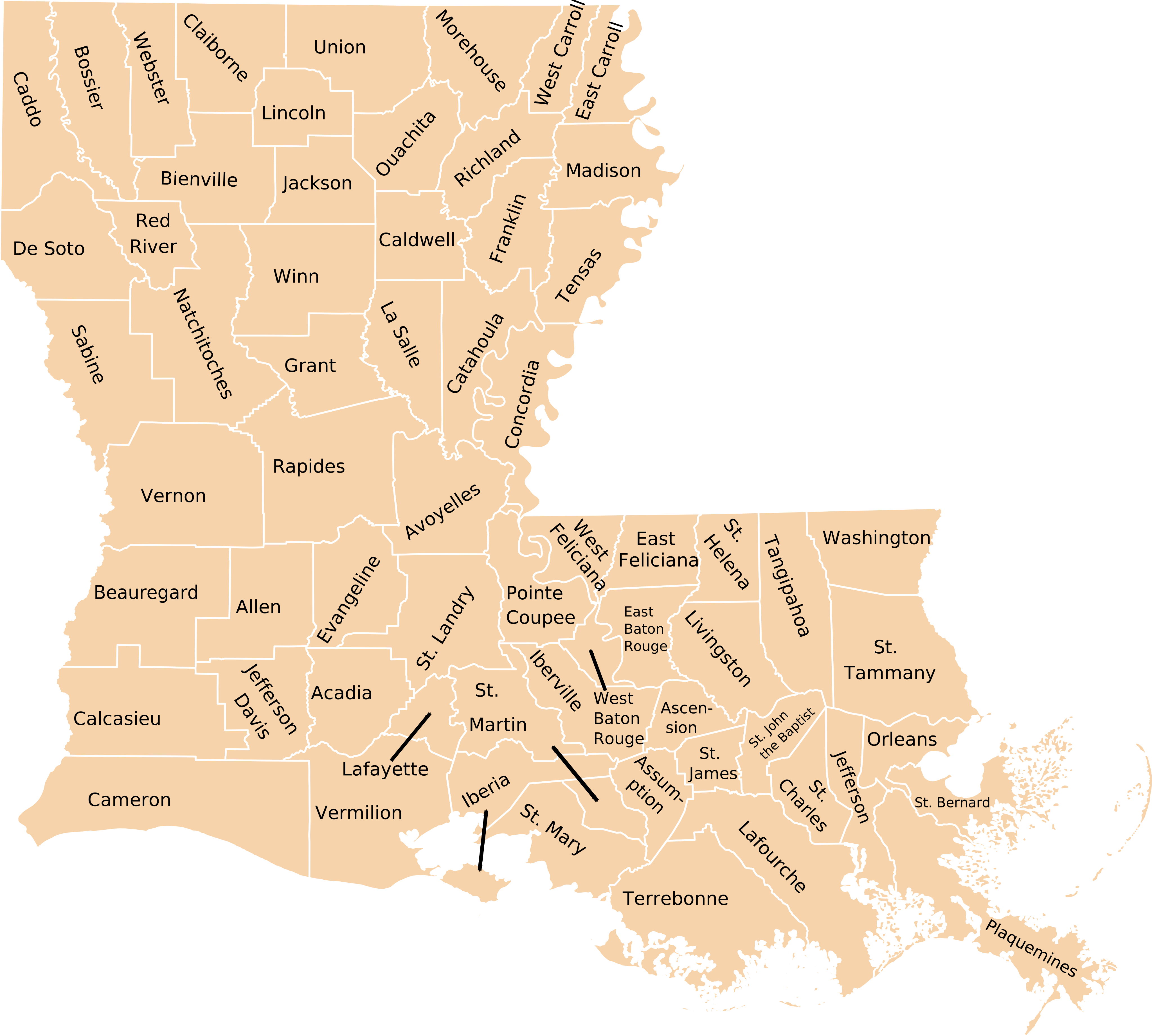
A homebuyer can open Zillow, drop a pin somewhere in Louisiana and start moving the map from Lake Charles toward Lafayette, Baton Rouge, Alexandria or New Orleans.
Nothing happens when they cross from one real estate association's territory into another. The search does not stop. Zillow does not ask which MLS they belong to or whether they have paid for access to the next market. The buyer may not even know those boundaries exist.
For the consumer, Louisiana already looks like one real estate market.
The experience can be very different for the licensed professional sitting beside them.
A Louisiana real estate license allows an agent to practice throughout the state, but access to the professional listing infrastructure remains divided among MLS organizations. An agent can cross an invisible boundary and suddenly be working with a different database, different rules, another subscription and information they may no longer be able to see directly.
That disconnect is becoming harder to justify as the rest of the real estate industry becomes more connected.
Zillow's real innovation was making the infrastructure disappear
There are plenty of legitimate complaints about Zillow.
A Zestimate is not an appraisal. Tax data can be wrong. Property characteristics can be incomplete. Automated valuations cannot reliably account for condition, renovations, drainage, location quirks or dozens of other things a knowledgeable local agent or appraiser would notice immediately.
But Zillow understood something important about how people actually search for real estate: buyers do not care how the industry divided the map.
They care about the house.
A buyer can draw a search area that crosses cities, parishes and MLS territories without ever knowing that several different organizations may be supplying the listings underneath it. Redfin offers much the same experience.
Those companies did not replace the MLS. Much of what makes their platforms useful comes from MLS data in the first place. Zillow receives for-sale listings through MLS feeds, and Redfin says it receives listing information directly from MLS systems.
What the portals did was hide the plumbing.
That has produced an odd situation in which the public-facing layer of real estate can sometimes feel more geographically unified than the professional infrastructure supplying it.
There is no technical reason professional data has to remain this fragmented.
The Real Estate Standards Organization has spent years trying to solve one part of the problem by creating common definitions and data standards so that thousands of real estate systems can communicate with one another. Standardization makes data exchange easier, but a shared MLS environment goes further. Agents can work from consistent statuses, fields, rules and listing records without constantly determining which database controls a property.
Louisiana has already spent years debating exactly that.
Louisiana considered broader MLS consolidation years ago
In 2017, Louisiana REALTORS® began studying MLS consolidation after brokers and local association leaders raised concerns about the existing system.
Louisiana had nine MLS systems at the time.
The organization's own summary of the discussions said brokers wanted lower costs where possible, consistent rules and enforcement, greater efficiency and access to real estate information "without borders or walls." It also acknowledged a more sensitive issue: some brokers questioned whether MLS operations should function as profit centers used to support other association activities.
Louisiana REALTORS® did not propose taking over the state's MLS systems or forcing them into a single statewide organization. It specifically said it did not want to operate a statewide MLS, and decisions about consolidation remained with the local organizations themselves.
That structure presented an obvious difficulty. The organizations being asked to consider removing MLS boundaries were also the organizations that controlled those boundaries and, in some cases, depended financially on operating them.
The statewide effort never produced one Louisiana MLS.
But the demand from brokers did not disappear.
Brokers eventually built ROAM themselves
On June 11, 2019, sixteen Louisiana real estate brokers met in Baton Rouge. According to an account later published by Inman, no REALTOR® association staff or MLS employees were in the room.
Their complaints were practical rather than theoretical.
Some brokerages belonged to multiple MLS systems. They were training agents on different platforms, working under different rules and paying multiple subscriptions. Some brokers were reportedly paying as many as four separate MLS fees to operate across the state.
What followed became ROAM MLS.
ROAM ultimately brought together MLS operations associated with New Orleans, Baton Rouge, Central Louisiana, the Bayou region and Acadiana. The important part of that story is not the ROAM name itself. It is that a substantial portion of the Louisiana real estate industry had enough difficulty with fragmentation that brokers created a new structure to reduce it.
The consolidation is still continuing.
ROAM is now moving its participating markets onto a single Flexmls environment. The organization says that change will reduce discrepancies, provide a common point for listing entry, simplify training and support, and eliminate the need for multiple ROAM subscriptions.
That progression is instructive. Organizational consolidation solved part of the problem, but multiple underlying systems still created enough friction that those systems are now being consolidated too.
Louisiana is not alone in going through this process.
Other states have already dealt with the same problem
Maine operates a statewide MLS through Maine Listings. Rhode Island has had a statewide MLS structure for decades.
Connecticut's experience may be more relevant to Louisiana because consolidation there was neither immediate nor easy.
The organizations that eventually formed SmartMLS had discussed consolidation for roughly 20 years. Earlier attempts failed. By 2016, there was enough geographic overlap between the systems that approximately 20 percent of members were paying to belong to both.
They initially considered sharing data between the two MLS systems rather than merging them. Ultimately, they concluded that maintaining two systems while trying to make them behave like one was not the best long-term solution.
They merged.
California took another approach. Rather than waiting for every MLS in an enormous state to agree to one simultaneous statewide conversion, California Regional MLS expanded through mergers, partnerships and data-sharing agreements. It now serves more than 100,000 real estate professionals across dozens of associations and boards.
The point is not that Louisiana needs to copy Connecticut, California, Maine or anyone else. Those states reached broader data access through different organizational structures.
What their experience demonstrates is that MLS boundaries are not an unavoidable feature of real estate.
They are administrative choices.
There are legitimate reasons to be cautious about consolidation
A statewide or broadly consolidated MLS would create real implementation problems.
Local markets sometimes use fields that genuinely matter locally. Lockbox systems vary. Technology contracts have expiration dates and financial obligations. A small association can reasonably worry about losing representation inside a much larger organization. Rules still have to be enforced, and local support remains useful when agents need help with practices unique to their market.
Those concerns do not require maintaining separate islands of listing data.
RESO has specifically encouraged MLS organizations to preserve useful local fields while standardizing data. ROAM provides another example: local REALTOR® associations can continue serving their members while the underlying MLS infrastructure becomes broader.
The more difficult objections have less to do with technology.
When the National Association of REALTORS® studied obstacles to MLS consolidation, executives and volunteer leaders raised concerns about governance, ownership, staffing, MLS revenue and control over finances and rules.
NAR's own consolidation material also identifies another obstacle with unusual clarity: "Desire to Keep Others Out of the Market."
That deserves more attention because MLS boundaries do not merely determine who sees a database. They can affect who gets access to a customer.
An information boundary can also become a business boundary
Consider a property listed in one Louisiana MLS and a buyer working with an agent who belongs to another.
The buyer may find the house on Zillow.
Their agent may know it exists.
But that agent may not have direct access to the originating MLS's agent remarks, attachments, showing information, listing history or other subscriber-only information. They may have to make additional calls, request documents from the listing side or obtain access to another system before they can work with the property as easily as an agent who already belongs to that MLS.
None of those obstacles make a transaction impossible. They do create friction.
Friction matters when the consumer has a phone in their hand and the listing agent's contact information sitting in front of them.
If the buyer goes directly to the listing side, that inquiry can become a buyer relationship. Instead of one brokerage representing the seller and another brokerage representing the buyer, the listing brokerage may have an opportunity to participate in both sides of the transaction, whether through another agent within the brokerage or, where legally permitted and properly disclosed, through dual agency.
Louisiana permits dual agency when the required informed written consent is obtained. There is nothing inherently improper about that arrangement when the law is followed and the clients understand it.
The concern is not dual agency itself.
The concern is that fragmented access to listing information can influence how a buyer reaches the transaction in the first place.
If one brokerage controls a significant amount of local listing inventory, easier access for every licensed agent in Louisiana also means easier access for competing buyer representatives. Maintaining a separate MLS does not prevent those outside agents from practicing in the market, but it raises the cost and inconvenience of doing so.
For the listing side, that friction can have economic value.
It can increase the chance that an unrepresented buyer contacts the listing brokerage directly. It can make an outside buyer's agent more dependent on the listing side for information. At the organizational level, a separate MLS can also preserve subscription revenue and local control.
None of that establishes why any particular MLS, board member, executive or brokerage opposes consolidation. There are legitimate reasons for disagreement, and motives cannot be assigned simply because someone prefers a local system.
But the financial incentives exist, and they should be part of the discussion.
NAR's own consolidation research acknowledges both the financial concerns and the desire among some market participants to keep competitors out. Those are not arguments invented by people attacking the MLS system. They were identified from within the industry itself.
Local expertise does not depend on restricting the database
Another concern deserves a different response.
Agents sometimes argue that broader MLS access allows people from outside an area to work in markets they do not understand.
That can absolutely happen.
Access to Lake Charles listing data does not make an agent knowledgeable about Lake Charles. Someone unfamiliar with Southwest Louisiana may not understand flood history, drainage, insurance issues, construction practices, neighborhood differences or any of the other local factors that matter when advising a client.
But MLS access and professional competence are different issues.
An agent who lacks the knowledge necessary to competently represent someone in a market has a professional responsibility to address that problem, whether by learning the market, involving another professional or referring the client.
Restricting access to listing information is a poor substitute for enforcing standards of competence.
The MLS was created around cooperation among competing real estate professionals. Brokers agreed that sharing listing information created a more functional marketplace than forcing every buyer and every agent to discover inventory independently.
It is difficult to argue that cooperation remains beneficial within one association's territory but becomes harmful when the agent viewing the information lives on the other side of an administrative boundary.
The consumer market already moved on
Many existing MLS boundaries are easier to understand historically than technologically.
Real estate associations developed locally because real estate itself was intensely local. Listing books were local. Data distribution was slow. Technology was expensive. Maintaining one regional database was once a meaningful logistical achievement.
That world is gone.
A buyer in Houston can spend tonight looking at houses in Lake Charles. Someone living in Lake Charles can browse property in Lafayette without noticing that the underlying MLS environment may have changed. A Louisiana listing can appear on national portals and brokerage websites across the country almost immediately after it is entered.
The public-facing real estate market has already become borderless.
The professional infrastructure has not completely caught up.
Louisiana does not necessarily need one organization controlling every listing in the state. It could reach the same practical result through a single MLS, several organizations sharing one database, reciprocal access, deeper regional consolidation or another structure that preserves local associations while removing unnecessary data barriers.
ROAM has already demonstrated that significant consolidation is possible in Louisiana, and its current move toward one Flexmls environment shows that even consolidated organizations continue finding value in removing additional layers of fragmentation.
What remains harder to defend is a system in which a consumer can search Louisiana more seamlessly than the licensed professional representing them.
MLS boundaries once reflected the practical limits of running a local real estate marketplace.
Technology removed most of those limits years ago.
The remaining boundaries are choices.
About the Author
Dalton Barron is an investigative reporter and Louisiana-licensed real estate salesperson affiliated with NextHome Bayou Pines.
His reporting focuses on public records, real estate, development, infrastructure, business, government, and local data across Southwest Louisiana.
Dalton Barron
NextHome Bayou Pines
Jeremy Jones, Broker/Owner
416 N. Pine St.
DeRidder, LA 70634
C: 337.764.1754
O: 337.202.1018
Licensed by the LREC
Each office is independently owned and operated.
Dalton’s real estate activities are separate from the editorial operations of 337.NEWS. The brokerage information above is included for transparency where reporting may intersect with real estate, development, property ownership, land use, infrastructure, or related industries.




Member discussion