500 Feet From a Data Center in Beauregard Parish. What Sound and Wildlife Research Says About That Distance
337.NEWS | November 21, 2026
DERIDDER, La. A number is doing most of the work in the Beauregard Parish data center debate right now: 500 feet.
On November 17, Johnny Tolbert posted that the Beauregard Parish Police Jury is considering an ordinance on data centers and is asking residents for feedback on possible restrictions. As an example, he mentioned a possible rule prohibiting structures within 500 feet of a neighboring property line. He asked people with concerns about noise, lighting, water use, or power use to contact the jurors.
That post does not say the Police Jury adopted 500 feet. It describes 500 feet as an example of a restriction under consideration.
A separate post on November 20, by Jeffrey Baker, opposed a data center ordinance that would permit a data center within 500 feet of a school. Baker argued that distance is irresponsible and advocated for a minimum setback of 2 miles instead, citing noise, vibration, and environmental hazards.
The two posts do not describe the same measurement. One refers to a neighboring property line. The other refers to a school. The Police Jury has not published a final ordinance text in the public sources checked for this article.
What has happened so far
On November 4, 2026, at 1:15 p.m., the Beauregard Parish Police Jury held a multi-topic workshop at the Police Jury Administration Building, 201 W. 2nd Street, DeRidder. The official notice, signed by Secretary Shannon Slaydon by order of President Eddie Ware and dated November 3, listed as an agenda item a discussion of data center requirements and restrictions.
The same day, at 3:30 p.m., the Police Jury held a special session. One item was a discussion and approval for three Police Jury representatives to attend the Broadband Nation Expo and Data Center Excellence Summit 2026 in New Orleans, November 18 to 20.
The American Press reported that the November 4 workshop, intended to focus on developing a parish ordinance to govern data centers, turned contentious as residents voiced strong opposition to the industry. The American Press also reported that the parish currently has a data center moratorium in place through the end of 2026 to allow officials time to establish regulations and requirements for such facilities.
On November 4, Police Jury member Kelly Bailey posted that data center discussions have been on the agenda multiple times, that no data center is being voted on at this time, and that an upcoming meeting would focus on reviewing ordinances from other parishes and sharing feedback from jurors who visited a data site.
As of November 21, no final ordinance, adopted setback distance, decibel limit, or next vote date was found in the public sources checked for this article.
What 500 feet means for sound
No data center has been built in Beauregard Parish under this ordinance, and no site-specific noise study for a Beauregard facility was cited in the sources checked. The figures below come from general data center noise research, not from a Beauregard measurement.
Continuous noise from cooling fans and transformers reaches 60 to 80 decibels at the property line, according to an independent data center noise brief by LSARS. Generator load tests can be heard up to a mile away. The same brief states that a 70-decibel measurement at 50 feet typically becomes roughly 60 decibels at 200 feet, 50 decibels at 800 feet, and 40 decibels at half a mile, in flat open terrain.
Generator load tests at 95 to 100 decibels at the source can remain audible at 4,000 to 5,000 feet, close to a mile, in still nighttime conditions, according to the same brief.
A Missouri homeowner guide, using a facility operating at 65 decibels at its fence line, puts the level at roughly 50 to 55 decibels at 500 feet, 45 to 50 decibels at 1,000 feet, 40 to 45 decibels at a quarter mile, and 32 to 37 decibels at one mile. At 500 feet, that is louder than a typical refrigerator and quieter than normal conversation, according to that guide.
The same guide notes that a 40-decibel hum in a place with a normal nighttime ambient level of 25 to 30 decibels is very noticeable. Rural nighttime background levels in the research cited for North Dakota were 30 to 35 decibels.
Low-frequency sound is the part that travels farthest. A policy guidance paper prepared in August 2026 by Kasey Fowler-Finn, a professor of biology at Saint Louis University, states that low-frequency noise travels farther and is substantially harder to mitigate than ordinary industrial or traffic noise, and is systematically undercounted by the dBA-based metrics most existing ordinances use. The paper states that low frequencies pass right through walls, windows, stands of trees and other buildings, and that the most severe impacts are concentrated within roughly 3,000 feet, more than half a mile, of the source, with noise reported as audible up to 2 to 2.5 miles from facilities.
The same paper states that many municipal setback requirements for data centers fall in the range of roughly 100 to 600 feet from residentially zoned parcels, schools, and parks, and that these distances are typically well within the range where low-frequency noise impacts have been documented and measured.
How 500 feet compares to other places
Tucson, Arizona, in a proposed code amendment fact sheet dated May 21, 2026, proposed a 2,640-foot setback from urban residential zones and noise-sensitive uses, including schools, and a 1,000-foot setback from commercial or office zones. That is 2,640 feet, a half mile, compared with 500 feet in Beauregard Parish.
A compilation of adopted and proposed data center ordinances prepared for Davidson County, North Carolina, and updated August 30, 2026, lists Troup County, Georgia, at 1,500 feet as the most restrictive setback found, Jackson County, Georgia, at 1,000 feet from residences, and Albemarle County, Virginia, at 500 feet. The compilation states that 200 feet is the most frequently adopted baseline.
Beauregard Parish has not adopted any of those figures. The comparison shows where 500 feet sits in that range: above the most common baseline of 200 feet, equal to Albemarle County, Virginia, and below Jackson County at 1,000 feet, Troup County at 1,500 feet, and Tucson at 2,640 feet.
What the research says about wildlife
No Beauregard-specific wildlife study for a data center site was cited in the sources checked. The findings below come from general wildlife and noise research.
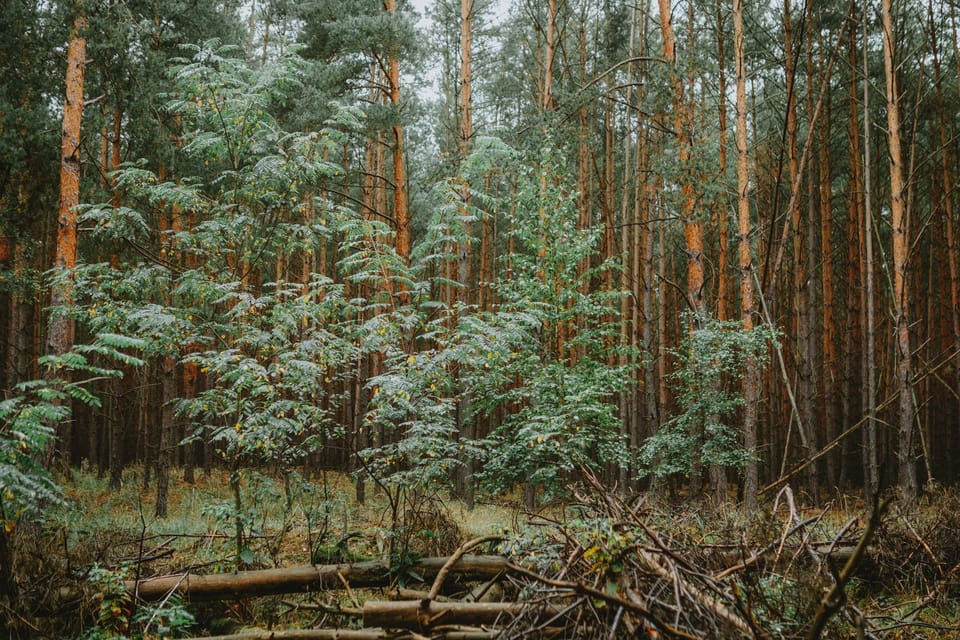
A fact sheet from the Utah Division of Wildlife Resources, prepared for a legislative committee meeting on August 19, 2026, lists habitat loss, habitat fragmentation, and habitat degradation as potential impacts from data centers and other large-scale projects. It states that during construction, wildlife habitat may be altered or removed for buildings, roads, transmission lines and other infrastructure, and that when habitat is converted to infrastructure, animals are sometimes displaced from areas crucial to their survival, such as winter ranges. Security fencing may prevent larger animals from accessing any remaining habitat within a facility.
The same fact sheet states that habitat can be fragmented by development, which can block wildlife movement and migration corridors, cutting off animals access to forage, water, shelter and mating opportunities. It also states that habitats adjacent to development may be degraded by sound pollution, light pollution, increased temperatures, disturbance and invasive species, and that data centers produce a constant 80 decibel sound that could impact an animal's ability to communicate or detect predators.
On birds, a review by Braxton Boren, Ph.D., summarizes research on continuous, low-frequency industrial sound, including natural gas compressor stations. In a study in New Mexico pinyon-juniper woodlands, noisy sites hosted 21 nesting species versus 32 species on quiet sites over three breeding seasons, even though overall nest density did not change. A follow-up analysis found that species that sing below about 2 kHz, which overlaps with where compressor noise concentrates its energy, had consistently negative nesting responses.
The same review cites research finding that hunting success in wild owls dropped by up to about 90 percent, depending on the noise level, with measurable effects extending more than 120 meters from the noise source. The review states clearly that none of the studies cited were conducted at an actual data center, and that the acoustic profile of a large data center maps onto the noise sources studied more closely than almost any other class of development.
What is still undecided
The ordinance is still pending. The public sources checked do not state a final setback distance, a final decibel limit, a requirement for an independent noise study, a generator testing schedule, or an enforcement mechanism.
Residents who commented on the November 17 posts asked for larger setbacks, including a mile, a half mile, and a quarter mile, and for decibel limits at property lines and closed-loop cooling mandates. Those are comments from residents, not adopted rules.
The question for the Police Jury is not only whether 500 feet is in the ordinance. It is what distance, what decibel limit, what measurement method, and what enforcement the final ordinance will contain, and when the Jury will vote on it.
Sources
- Beauregard Parish Police Jury, Notice of Public Hearing, multi-topic workshop, November 4, 2026, 1:15 p.m., and special session, 3:30 p.m., via Whitney Bass Fritzinger post
- American Press, Beauregard Police Jury fields data center questions, accusations during meeting, via Pamela Sleezer articles listing
- Johnny Tolbert post, November 17, 2026, Police Jury considering data center ordinance, 500 feet example
- Johnny Tolbert post in group, November 17, 2026, 34 comments on 500-foot setback
- Jeffrey Baker post, November 20, 2026, 500 feet from a school, 2-mile proposal
- Kelly Bailey post, November 4, 2026, no data center being voted on at this time
- LSARS, Data Center Noise: How Loud, How Far, How to Address
- Missouri Data Centers, How Loud Are Data Centers at Night?
- Kasey Fowler-Finn, Ph.D., General Guidelines for Regulating Data Center Noise, August 2026
- City of Tucson, Large-Scale Data Centers Proposed Code, Amendment Fact Sheet, revised May 21, 2026
- Davidson County, North Carolina, Data Center Ordinance Standards: What Other Jurisdictions Have Adopted, updated August 30, 2026
- Utah Division of Wildlife Resources, Impacts of data centers on wildlife, August 19, 2026
- Braxton Boren, Ph.D., The Hum in the Woods: What We Know About Data Center Noise and Birds, August 6, 2026

Member discussion
337.NEWS discussion
Join the conversation.
Sign up to comment on this story and follow the local reporting behind it.