Louisiana Authorized Up to $6.8 Million for SpaceX Road Planning. Who Pays to Build the Roads?

Louisiana has signed an agreement authorizing up to $6.8 million in state-funded engineering services connected to SpaceX’s proposed Starbase Louisiana development in Vermilion Parish. But the agreement, as described in reporting published November 10 by The Center Square, does not establish how much taxpayers might ultimately pay to construct or improve the roads and bridges the project will need.
That is a consequential omission for a project Louisiana has promoted as a $100 billion private investment.
The contract is with Royal Engineers & Consultants, a New Orleans-based engineering firm. Its scope reportedly covers road and bridge assessments, traffic studies, engineering design, permitting, utility coordination, assistance with property acquisition and construction oversight. The $6.8 million is a ceiling for professional services, not an announced construction budget, and there is no evidence in the available reporting that the full amount has been spent.
More importantly, the contract reportedly does not require SpaceX to reimburse the state for Royal’s services. That does not mean SpaceX will never pay for transportation improvements; Louisiana Economic Development says some cost-sharing is expected. It means the public still does not have a definitive accounting of which expenses will fall to SpaceX and which could fall to taxpayers.
The $6.8 million is just the planning contract
According to The Center Square, the agreement does not name specific roads or bridges for improvement and does not establish the total infrastructure budget. DOTD must approve a project budget and issue a written notice to proceed before Royal can incur compensable costs. The reporting did not establish whether such authorization has been issued or what, if anything, Royal has been paid.
That leaves several materially different figures unresolved: the authorized engineering-services ceiling, actual engineering expenditures, the eventual cost of physical road and bridge construction, and the amount ultimately reimbursed or funded by SpaceX.
They should not be conflated.
Louisiana’s own explanation leaves the cost split open
In its official SpaceX project FAQ, Louisiana Economic Development says DOTD is evaluating transportation routes, existing road and bridge conditions, expected traffic and potential improvements to Louisiana Highway 82.
Asked who will pay for the improvements, the agency says DOTD and the project team are still determining the scope and responsibility, with some cost-sharing expected between the state and SpaceX.
In other words, Louisiana has authorized a multimillion-dollar engineering-services contract while the public allocation of costs for the larger transportation project remains unsettled.
Road improvements can benefit residents and other businesses, not just one company. But the public should be able to distinguish ordinary infrastructure improvements from upgrades needed principally to accommodate a private development’s oversized cargo, heavy equipment and construction traffic.
The permit drawings show why transportation matters
A separate set of preliminary drawings dated November 9, 2026, prepared for the proposed Southwest Louisiana Coastal Infrastructure Improvement Project in Vermilion Parish, depicts a substantial logistics network: a proposed roadway and access connection, a Gulf Wharf with multiple berths, large breakbulk and module-marshalling yards, and space marked for assembly, testing and heavy-haul operations.
One vicinity plan connects proposed access infrastructure to Freshwater City Road (Highway 3147); the state’s transportation FAQ separately identifies Highway 82 for possible improvements. These are not interchangeable locations, and the available records do not establish which segments, if any, will be covered by Royal’s contract.
The drawings help explain why transportation planning would be necessary. They do not, by themselves, establish that any particular public road project has been approved, funded or ordered for construction.
They also raise a related question: If logistics infrastructure proceeds before any launch complex is built, which transportation expenses are considered essential to the logistics operation, and which are justified by the state’s longer-term spaceport projections?
The contractor’s political contributions deserve scrutiny, not assumptions
Royal’s selection also comes with a political-finance question.
In an October 29 report, The Center Square identified $115,000 in contributions by Royal to Cajun PAC II, a political action committee affiliated with Gov. Jeff Landry, plus at least $27,000 in direct contributions to Landry’s campaigns since 2014. The outlet reported that DOTD did not answer whether the SpaceX-related contract was competitively bid.
At least one part of that account is directly documented in a public filing: Cajun PAC II’s June 2024 campaign-finance report lists a $50,000 contribution from Royal Engineers & Consultants on June 25, 2024. The broader totals above remain attributed to The Center Square pending an independent transaction-by-transaction audit.
Political contributions are not proof of an improper award. Royal also has documented experience in Louisiana road and bridge engineering. The legitimate public-interest questions are whether the contract was competed, what selection criteria applied, who approved the award, and whether its terms protect the state.
What Louisiana has promised, and what has actually happened
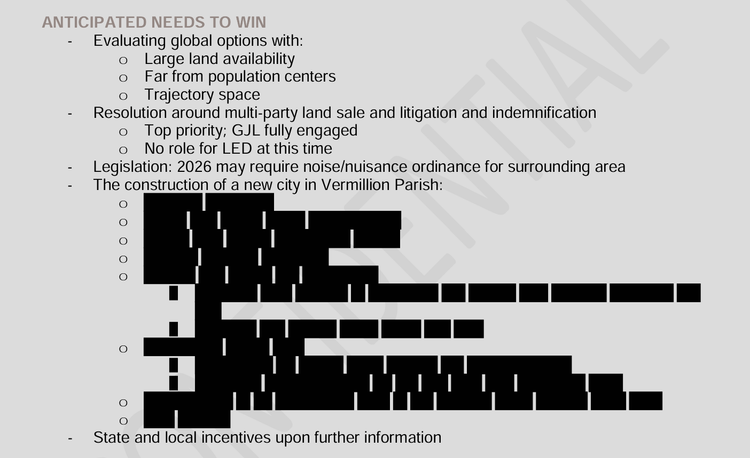
Louisiana Economic Development’s August 25 announcement describes an eventual $100 billion SpaceX campus, 3,000 direct jobs over 10 years and a facility capable of thousands of launches annually at full development. The state’s current project FAQ targets construction beginning by the end of 2027 and a first launch as soon as 2029.
Those are announced plans and projections, not construction milestones already achieved.
LED says SpaceX’s economic-development incentives are performance-based and that state agreements contain accountability provisions. But that assurance, on its own, does not establish whether road-planning costs would be recoverable if the company delays, reduces or cancels its Louisiana development. Engineering contracts and corporate incentive agreements may contain different obligations.
The central question is therefore not whether Louisiana should prepare for a major industrial project. It is whether the state has adequately defined and disclosed the public financial risk before making potentially project-specific commitments.
Six records that would settle the biggest questions
- The fully executed DOTD–Royal agreement, including its exact contract number, maximum compensation, term, procurement authority and amendments.
- The solicitation, evaluation sheets and selection memorandum, or an explanation of why competitive selection was not required.
- Every approved task order, work authorization, budget and notice to proceed, with dates.
- Invoices and payments to date, separating authorized spending from actual disbursements.
- Any DOTD–SpaceX cost-sharing, reimbursement or infrastructure agreements, including draft or final schedules of responsibility.
- The road and bridge inventory, traffic studies and proposed improvement map, identifying work required primarily by project-related traffic.
Until those records are public, the available evidence supports a narrower but important conclusion: Louisiana has authorized up to $6.8 million for engineering services supporting SpaceX-related transportation planning, while the ultimate public cost of building or upgrading the transportation network remains undetermined.
A promise of a $100 billion investment does not make the state’s share of infrastructure costs irrelevant. It makes transparent accounting more important.
Sources and reporting notes
- Original contract reporting: Nolan McKendry, The Center Square, November 10, 2026, republished by Newsline Local. This is the source for the contract ceiling, scope, reimbursement provision and outstanding work-authorization questions. The signed contract packet has not been independently obtained for this article.
- Prior contractor and political-contribution reporting: Nolan McKendry, The Center Square, October 29, 2026, republished by Newsline Local.
- Original political-finance record: Cajun PAC II, June 2024 report, p. 6, recording Royal’s $50,000 contribution.
- Official state project details and transport cost-sharing statement: Louisiana Economic Development, SpaceX project FAQ.
- Official project announcement: Louisiana Economic Development, August 25, 2026.
- Related public-records repository: 337.NEWS Louisiana Public Records.
- Permit-plan context: Gulf Wharf Permit Set, Pecan Island, Vermilion Parish, sheets 1, 2 and 4 of 28, dated November 9, 2026, supplied to 337.NEWS. These plans are preliminary and are not evidence of a DOTD construction award.

Member discussion
337.NEWS discussion
Join the conversation.
Sign up to comment on this story and follow the local reporting behind it.