SpaceX Promised Louisiana a Spaceport. Its Revised Permit Could Support a Logistics Hub Without One.
Louisiana was promised rockets. The paperwork currently under review describes something that could be useful even without them.
In August, Louisiana Economic Development announced that SpaceX would invest a proposed $100 billion in a Vermilion Parish spaceport, eventually supporting thousands of launches annually. The state projected 3,000 direct jobs over a decade, with the first launch targeted as early as 2029.
But newly revised coastal-use plans dated November 9 show what SpaceX is asking to construct first: an extensive system of roads, marine terminals, cargo yards, assembly areas, warehouses and material-handling facilities near Pecan Island. The plans contain no launch pads or launch towers.
That difference does not mean the spaceport has been canceled. It does raise a question Louisiana should answer before approving major changes to its coastline: If the rockets never launch from Vermilion Parish, what exactly will SpaceX still have permission to build and operate?
The revised plans describe a major industrial port
The drawings submitted under coastal-use permit application P20260831 identify a proposed Gulf Wharf at the southern end of Freshwater City Road (Louisiana Highway 3147), beside Freshwater Bayou Canal.
The long-term operations plan labels a 60,000-square-foot assembly hall, a 112,500-square-foot transit shed, four module assembly bays, two module marshalling yards, several breakbulk cargo yards, bulk-material stockpiles, a conveyor and hopper system, and parking and maintenance areas.
It also identifies dedicated berths for roll-on/roll-off cargo, breakbulk shipments, bulk cargo, inland barges and tugboats. Other labeled features include test pads and a blast shelter. Those terms warrant examination, but they are not proof that the application authorizes rocket testing or orbital launches. The drawings do not specify such activity.
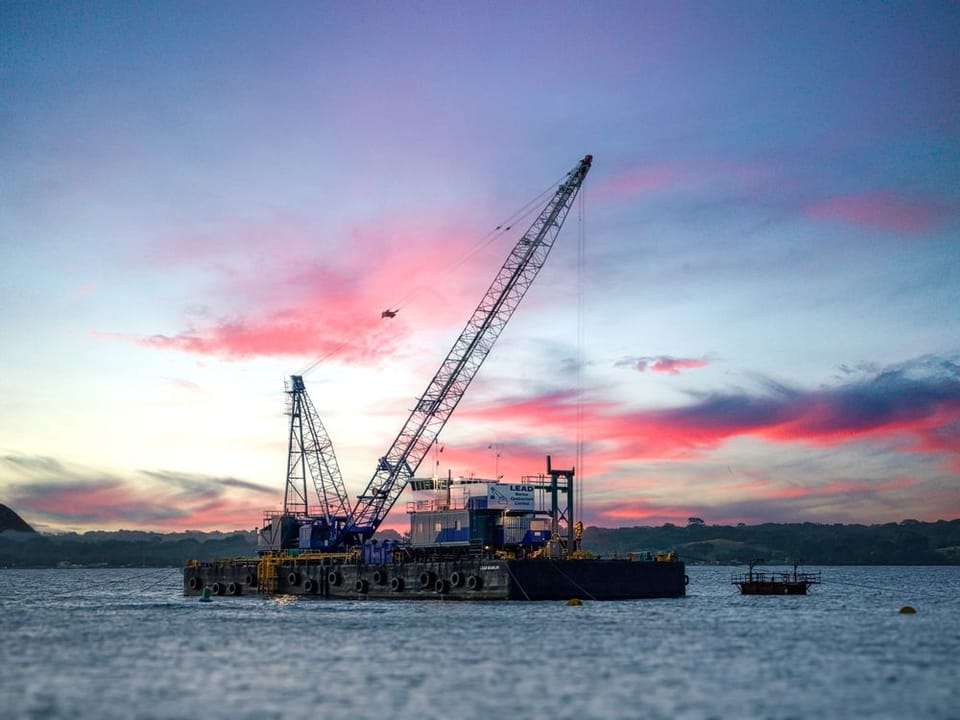
The Gulf Wharf overview depicts a proposed wharf and laydown area along Freshwater Bayou Canal. The vicinity drawing shows access to the Gulf of Mexico, temporary construction areas, dredging, and a proposed road connecting the coastal facilities to the broader project.
These are plans marked “Preliminary — For Permit Purposes Only,” not evidence that construction or operation has been approved.
More than 1,100 acres of proposed impacts
An accompanying project quantities table, supplied with the revised plan images and labeled for application P20260831, indicates approximately 1,183.85 acres of wetlands and waters impacts across the project components. Its fill summary lists approximately 14.68 million cubic yards of material placed on-site, including approximately 13.84 million cubic yards in wetlands or waters.
Those figures are applicant-provided estimates in the materials reviewed, not independently measured impacts or a final agency determination. The impact categories include temporary and permanent work; the 1,183.85 acres should not be described as all permanently destroyed wetlands.
A comparison published by permit watcher @LouisianaModelY reports that the prior September submission estimated approximately 888 acres of wetland and water-bottom impacts and 11.2 million cubic yards of fill. If the application versions use comparable boundaries and accounting methods, the revision represents a substantial increase. The original full quantities schedule has not been independently reconciled against the revised schedule for this article.
The revised application also reportedly expands proposed marsh-creation work. Marsh creation may offset or mitigate impacts, but a proposed mitigation feature is not the same as an agency finding that impacts have been adequately mitigated.
Why the word “independent” matters
A social-media analysis of SpaceX's revised 82-page narrative says the company specifically describes the logistics project as having independent utility, without depending on facilities outside the application. The same account says the narrative emphasizes moving materials purchased or fabricated by Louisiana suppliers to SpaceX operations in Texas and Florida.
337.NEWS has reviewed the supplied plan sheets and quantities image, but has not obtained the complete 82-page narrative to verify the exact wording or context of that independent-utility statement. The characterization should therefore be treated as a reported claim, not an authenticated quotation from the application.
Even if confirmed, independent utility is not automatically evidence of wrongdoing. It is an important concept in project scoping and environmental review: a wharf that serves a genuine standalone transportation purpose can be proposed and evaluated separately from other facilities, subject to the applicable regulatory requirements. Whether the complete development must receive a broader cumulative-impact analysis is a distinct question for the permitting agencies.
What matters for Louisiana is the practical result. A functional cargo terminal could move large industrial modules, equipment and construction materials to other SpaceX facilities. It could potentially remain useful if the timetable for the Louisiana launch complexes slips, changes or never materializes.
That is not the same economic outcome as the spaceport announced in August.
Louisiana's financial commitments deserve their own review
The state announcement describes a performance-based incentives package tied to investment and employment commitments. It also identifies the state’s Aerospace Facilities and Activities Rebate, the High Impact Jobs program and customized workforce support.
Louisiana Economic Development says local taxing bodies negotiated a payment-in-lieu-of-taxes agreement providing a $20 million upfront payment plus at least $25 million annually for 25 years, with an escalator. SpaceX also committed to a $25 million charitable donation as part of the incentive arrangements.
LED's public FAQ says SpaceX must meet applicable investment, hiring and other commitments to earn state incentives. That is an important safeguard. But the FAQ does not establish whether completing a logistics hub, without launching rockets in Louisiana, would satisfy particular contractual milestones or qualify for specific rebates.
The controlling agreements, definitions of qualified expenditures, job-creation benchmarks, payment schedules and any clawback provisions need to be examined. Until then, it would be inaccurate to claim that SpaceX could collect the full incentive package for a logistics-only development.
Five questions regulators and officials should answer
- What work is being approved now? Does this coastal-use application cover only roads, canals and cargo facilities, and what additional permits are required for rocket manufacturing, testing and launching?
- How independent is the logistics hub? If no Louisiana launch pad is ever built, can the wharf, assembly areas and cargo terminals operate indefinitely under the approvals being sought?
- How will impacts be evaluated? Will agencies consider reasonably foreseeable launch-complex construction and operations when evaluating cumulative coastal and ecological effects, even if those elements are submitted separately?
- What happens to the promised jobs and incentives? Which enforceable agreements require a Louisiana launch site, rather than construction spending or logistics employment alone?
- What is temporary and what is permanent? What enforceable restoration, monitoring, mitigation and financial-assurance requirements apply to the temporary canals, staging areas, dredging and wetland impacts?
A port is not a spaceport
A successful logistics operation could still generate jobs for Louisiana suppliers, marine contractors, truckers, fabricators and construction workers. The revised plans do not prove that SpaceX intends to abandon its spaceport commitment.
But public approvals should be evaluated against the facilities actually proposed, not simply against the most ambitious version of a project announced at a press conference.
Louisiana has every reason to welcome legitimate industrial investment. It also has every reason to insist that the public understand precisely what is being built, what environmental costs are contemplated, what jobs are contractually guaranteed, and what happens if a promised launch complex remains only a promise.
For now, the plans show a significant industrial logistics development on the Louisiana coast. The rockets remain a separate question.
Documents and sources
- SpaceX coastal-use permit P20260831, application 36343. Gulf Wharf Permit Set, DDG, sheets 1, 2 and 4 of 28, dated November 9, 2026; and applicant's project quantities table. Images reviewed directly by 337.NEWS. These are preliminary application documents, not issued permits.
- Louisiana Economic Development, August 25, 2026: SpaceX Launches New Era of Commercial Spaceflight with $100 Billion Louisiana Campus.
- Louisiana Economic Development: SpaceX in Louisiana: project details, incentives and FAQs.
- Louisiana Office of Coastal Management: How to access and comment on coastal-use permit files. Search permit P20260831 and inspect electronic attachments.
- Louisiana Administrative Code, Title 43, Part I, §723: Coastal-use permit procedures and public participation.
- Independent application comparison: @LouisianaModelY, November 10–11, 2026. Comparative figures and narrative descriptions attributed to this researcher pending original-document verification.
- 337.NEWS public-records repository: Louisiana Public Records. Repository reference; this link does not by itself verify that the revised SpaceX files have been archived there.
Editorial verification note: The complete revised 82-page narrative, incentive contracts and agency determination were not independently obtained for this report. Claims based exclusively on third-party readings of the narrative are explicitly attributed. The submission is a request for authorization, not evidence of permit issuance.

Member discussion
337.NEWS discussion
Join the conversation.
Sign up to comment on this story and follow the local reporting behind it.