Federal Regulators Want to Fast-Track LNG Expansions. A Louisiana Developer Wants Stricter Rules for Protests.
Federal regulators are considering a way for existing liquefied natural gas facilities to make certain changes, including some major additions, without obtaining a separate, project-specific federal authorization order every time.
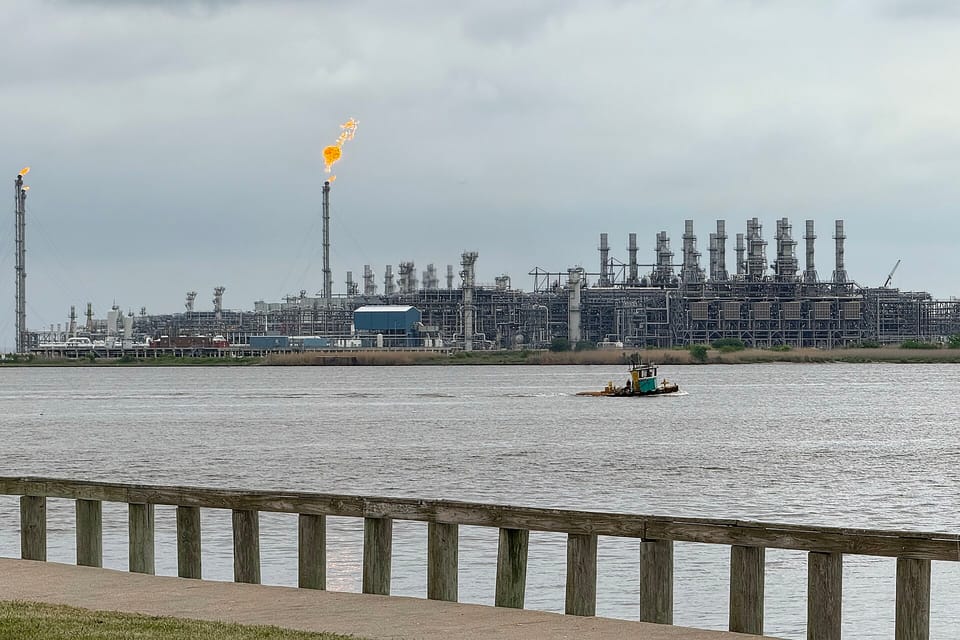
For Southwest Louisiana, this is not a distant policy debate. The Federal Energy Regulatory Commission's (FERC) rulemaking identifies two companies operating or building LNG projects in the region among those that submitted comments: Woodside Energy, owner of Woodside Louisiana LNG near Carlyss, and Cheniere Energy, owner of Sabine Pass LNG in Cameron Parish.
The proposal could speed modifications at eligible facilities. It also raises a more difficult question: How much industrial expansion should be allowed through a shortened approval process, and how much opportunity should nearby residents have to challenge it?
The rule is not final. Public comments on docket RM26-2-001 are due December 21, 2026.
What FERC is proposing
On October 15, FERC unanimously voted to issue a proposed rule establishing a blanket authorization program for certain work at existing LNG plants. The proposal was published in the Federal Register on October 20.
A blanket authorization would let a facility undertake defined categories of work under previously established requirements, rather than requiring a new, individualized FERC authorization order for every qualifying project. It is not an exemption from all federal or state law.
The proposed program has three tiers:
- Automatic authorization: Qualifying changes that do not increase authorized capacity, expand the authorized footprint, or exceed applicable design limits could proceed without an individual advance approval. Certain landowner and municipal notices could still be required, depending on the work.
- 60-day prior notice: Certain changes that could increase capacity but remain within the existing plant footprint would go through a notice-and-protest process.
- 90-day prior notice: Certain new facilities, including liquefaction trains, LNG storage tanks, marine berths and associated systems, could qualify for a longer notice-and-protest process, even where an eligible expansion extends outside the existing footprint.
FERC argues that the approach would reduce repetitive regulatory work while preserving safety and environmental requirements. But the scope of the third tier is where the debate becomes especially important for Louisiana communities.
What can fit on 25 acres?
Under the proposed 90-day category, eligible new construction outside an existing facility's footprint would generally have to occupy no more than 25 acres of adjacent land or waterways that were previously disturbed or developed, in an industrial-zoned area or an area without zoning. Other restrictions would apply, including requirements concerning facility type and existing environmental and engineering conditions.
Twenty-five acres might sound like a small addition to a major industrial complex. FERC's own staff analysis puts that figure in a different light.
According to the proposed rule, the space could accommodate two LNG storage tanks, one large liquefaction train, approximately 10 smaller liquefaction blocks, or five combined-cycle power generation facilities. These are alternative examples of possible configurations, not a claim that one property could contain all of them or that any such construction has been approved in Louisiana.
The agency says its experience with prior projects supports the proposed limit. Commissioner Judy Chang disagrees that the record yet establishes 25 acres as a reliable measure of minimal impact.
Chang supported issuing the proposal, but wrote separately that a major new liquefaction train or power-generation facilities could introduce substantial environmental and safety effects despite fitting within the acreage threshold. She questioned whether the proposed limit could let projects too large for a blanket program qualify.
Her concern is not whether LNG facilities should ever expand. It is whether the agency has drawn the line in the right place between routine modifications and projects that warrant a full, case-specific authorization process.
Woodside asked for more demanding protest requirements
The most direct Southwest Louisiana connection is in the public comment record.
FERC's proposed rule identifies Woodside as the owner of Woodside Louisiana LNG, formerly Driftwood LNG, under construction near Carlyss in Calcasieu Parish. Woodside supported automatic authorization for modifications that do not materially change a facility's previously authorized environmental footprint or LNG capacity.
Woodside also urged FERC to set minimum standards for protests. Its January 26 comments, as summarized by FERC, called for protesters to identify a specific substantive issue, explain the grounds for their objection in detail, and provide substantial supporting evidence that they would be materially and adversely affected.
That is Woodside's position, not an adopted federal rule.
FERC's actual proposal generally follows its existing pipeline-blanket model, which permits dismissal of protests that fail to raise a substantive issue or provide a specific rationale. But regulators are explicitly asking whether the final rule should go further, including whether protest rights should be limited to people with a demonstrated substantial interest, affected landowners and commission staff.
That difference could matter. Someone who lives near an LNG complex may have concerns about traffic, noise, emergency planning or air emissions. The question is what they would need to establish before their objection could prevent a project from receiving streamlined authorization.
The proposed process also contains a meaningful protection: a qualifying substantive protest that is not withdrawn or dismissed would prevent automatic approval under the blanket procedure and send the request into the ordinary case-specific authorization process. It would not necessarily defeat the project.
Cheniere's position matters in Cameron Parish
Cheniere, whose Sabine Pass LNG terminal operates in Cameron Parish, also participated in FERC's earlier request for comments.
The proposed rule records Cheniere's support for a more streamlined approach to in-footprint modifications. Cheniere argued that public notice for routine work within a previously authorized boundary should be limited, and proposed notifying affected landowners in connection with activity outside that boundary. It also opposed requiring separate notices to proceed for blanket activities, describing the additional process as unnecessary administrative work.
Again, these are positions submitted by the company, not evidence that FERC approved any particular Sabine Pass expansion or adopted every proposal Cheniere made.
The significance is that two companies with substantial projects in Southwest Louisiana are not merely observers. Their submissions are part of the regulatory record that will shape how future LNG work may be reviewed nationwide.
Could the public find out after the work is finished?
For the smallest tier of qualifying work, FERC proposes no blanket-program advance filing with the commission beyond existing inspection and reporting obligations. The agency would require completed automatic-authorization activities to appear in semiannual operational reports.
In the rulemaking, state officials and environmental advocates raised concerns that such work might not become publicly visible until after completion. FERC expressly acknowledges that possibility and says the proposed semiannual reporting would nevertheless make information available sooner than the annual reporting used for comparable pipeline activities.
The proposed regulation also includes notices to affected landowners and municipalities 45 days before some automatic-authorization construction, with exceptions for activities that do not disturb ground, change operational air or noise emissions, or adversely affect hazards or safety. So it would be inaccurate to say every automatic activity could occur with no notice to anyone.
Still, there is a basic transparency question: If nearby residents learn of a modification only after it has been completed, what meaningful chance did they have to evaluate it beforehand?
The more substantial 60- and 90-day projects would remain subject to advance public filings and an opportunity to protest. The proposal also calls for project-specific environmental analysis for prior-notice projects, either through an applicable categorical exclusion or an environmental assessment. FERC says it is not creating new categorical exclusions in this rulemaking.
What does this mean for environmental permits?
A streamlined FERC authorization would not, by itself, cancel other applicable requirements. Air, water, coastal, endangered-species, historic-preservation and safety obligations may still apply depending on the project.
For Louisiana, that means federal authorization and separate state environmental permitting must not be confused. A company could qualify for a new FERC process and still need relevant permits or approvals from other agencies.
But a faster FERC timetable could change when residents, local officials and regulators first see a project presented for consideration. That makes the exact notification, reporting and protest rules important even where other permits remain necessary.
The question for Southwest Louisiana
Calcasieu and Cameron parishes already live with the practical consequences of major LNG development: industrial construction, roads, port traffic, workforce demand and questions about emissions and emergency response.
The federal proposal is not proof that Woodside, Cheniere or any other specific operator has applied to construct a new facility under this system. No such approval is established by this rulemaking.
What it would do, if finalized substantially as proposed, is change the authorization pathway available for qualifying work at existing LNG plants.
FERC sees an opportunity to remove unnecessary delay. The industry sees a way to complete work with more predictable review. Commissioner Chang's concurrence and the public comments raise a different concern: whether projects that can be physically contained within 25 acres necessarily have limited impacts, and whether affected people will have adequate notice and a meaningful opportunity to object.
Those questions are especially relevant where industrial development has become a defining feature of local economic policy.
The public can comment on the proposed federal rule through December 21, 2026, using docket RM26-2-001. Comments on this rulemaking concern the nationwide framework; they are not protests against a particular existing LNG project.
Source documents
- Federal Register: proposed LNG blanket authorization rule, October 20, 2026, docket RM26-2-001. Primary legal text, including proposed procedures, commenters' positions, and environmental requirements.
- FERC: October 15 announcement of the proposed LNG authorization program. Summary of the three tiers and regulatory rationale.
- FERC: the proposed rule itself (Notice of Proposed Rulemaking). Full text of the NOPR in docket RM26-2-001; the earlier notice of inquiry used docket RM26-2-000.
- FERC: Commissioner Judy Chang's October 15 concurrence. Concerns about the 25-acre eligibility threshold.
- 337.NEWS Louisiana Public Records Repository. Public-records research archive maintained by 337.NEWS; not a substitute for the FERC primary documents linked above.
Editor's note: This report describes a proposed federal rule as of November 11, 2026. It does not describe an enacted regulation or approval of an individual LNG expansion. Statements attributed to Woodside and Cheniere are drawn from their positions as recorded in FERC's published rulemaking.
Photo: Cheniere's Sabine Pass LNG terminal in Cameron Parish. Photo by Quintin Soloviev, via Wikimedia Commons.




Member discussion
337.NEWS discussion
Join the conversation.
Sign up to comment on this story and follow the local reporting behind it.