Qatar Is Buying Louisiana LNG to Protect Itself From the Next Middle East Energy Crisis
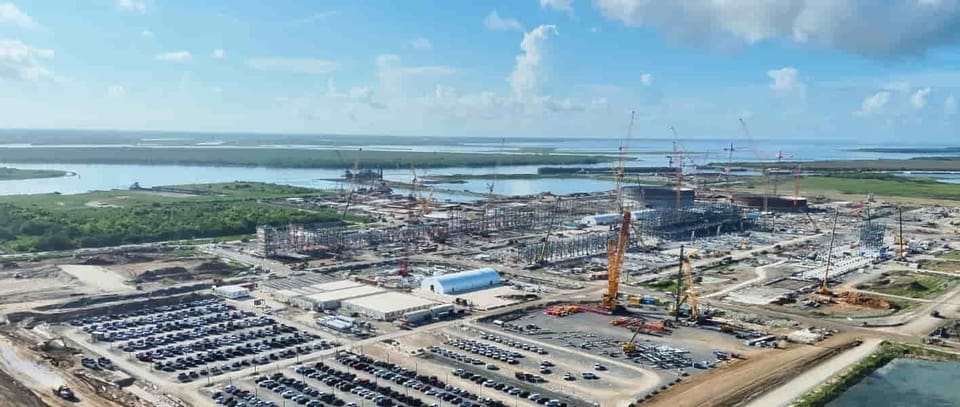
An Australian-owned energy developer is building a $17.5 billion LNG facility in Calcasieu Parish. Now Qatar's state-owned energy company has signed a 20-year agreement to purchase its natural gas, part of a global strategy to protect revenue when conflict disrupts Middle Eastern energy exports.
Qatar is one of the world's largest exporters of liquefied natural gas. It has enormous natural gas reserves, major production facilities, and customers around the world.
Now it is buying natural gas from Southwest Louisiana.
On October 29, 2026, QatarEnergy, the state-owned energy company of Qatar, signed a 20-year agreement to purchase up to 3 million metric tons of liquefied natural gas annually from a facility under construction in Calcasieu Parish.
The seller is Woodside Energy, an Australian company headquartered in Perth that controls and operates the Louisiana LNG development near Lake Charles.
Woodside acquired the project in October 2024 when it purchased Tellurian, the American company originally developing the facility under the name Driftwood LNG. In 2025, Woodside brought in Stonepeak, an American investment firm, as a 40% partner in the project's infrastructure company.
Woodside retained operational control.
The arrangement is relatively straightforward. An Australian energy company controls the development of a major LNG export facility on Louisiana soil. An American investment firm is helping finance its construction. And Qatar's national energy company has agreed to purchase a portion of its future production.
Qatar is not purchasing the facility itself, nor is Australia buying Louisiana's natural gas on behalf of its government.
But the agreement raises an interesting question.
Why would one of the world's largest natural gas exporters commit to buying American gas for the next 20 years?
The answer has more to do with international conflict than a shortage of natural gas.
A vulnerability thousands of miles from Louisiana
The Strait of Hormuz is a narrow shipping passage connecting the Persian Gulf to international waters.
For Qatar, it is one of the most important geographic features in the country's energy economy.
Qatar produces substantial quantities of natural gas, chills it into liquid form, and loads it onto specialized tankers for delivery to customers overseas.
Much of that export trade depends on ships passing through the strait.
That dependency became a serious problem in 2026.
During the conflict involving Iran, attacks damaged parts of Qatar's Ras Laffan industrial complex, one of the world's most important LNG production centers. Two LNG production trains were damaged, reducing the country's available export capacity.
According to Reuters, the damaged trains accounted for approximately 17% of Qatar's LNG export capacity, and repairs could take three years.
Production disruptions and restrictions affecting shipments through the Strait of Hormuz forced QatarEnergy to declare force majeure on affected customer commitments. Force majeure is a contractual provision invoked when extraordinary circumstances prevent a party from fulfilling obligations under agreed terms.
Qatar was suddenly confronting a problem that its enormous natural gas reserves could not solve.
Having the gas is not the same as being able to produce, transport, and sell it.
And for a country whose economy depends heavily on international energy exports, that creates a substantial financial risk.
Why Louisiana matters to Qatar
American LNG export facilities offer something Qatar's domestic terminals cannot: geographic separation from the Persian Gulf.
A tanker leaving an LNG terminal near Lake Charles does not need to pass through the Strait of Hormuz.
That allows QatarEnergy to purchase American-produced natural gas and market it internationally, even when its own facilities or shipping routes face disruptions.
The company has been explicit about this strategy.
In an October 29 interview with Reuters, QatarEnergy CEO Saad Sherida Al-Kaabi explained that the company was securing long-term American LNG supplies partly to protect its business against future closures of the Strait of Hormuz.
The strategy is not limited to replacing lost gas.
If a future conflict restricts Middle Eastern exports, international natural gas prices could increase sharply. QatarEnergy could potentially benefit from selling American LNG into those markets while its own production is disrupted.
In other words, the company is creating a way to continue supplying customers and generating revenue during the very circumstances that threaten its existing export business.
This is particularly significant because QatarEnergy does not need to construct or operate the Louisiana facility to benefit from the arrangement.
Woodside is responsible for developing the project and delivering LNG under the terms of the agreement.
QatarEnergy becomes a long-term purchaser with access to production outside the region where its own operations face geopolitical risk.
The company can then use its international trading and shipping operations to market that supply.
It is an insurance strategy built around geography, contractual rights, and global energy prices.
The $17.5 billion Louisiana LNG project
Woodside's Louisiana LNG development is under construction in Calcasieu Parish, southwest of Lake Charles.
The project was originally developed by Tellurian as Driftwood LNG before Woodside acquired the company in 2024.
In April 2025, Woodside approved a $17.5 billion investment in the project's initial development phase.
Louisiana Economic Development described the announcement as the largest single foreign direct investment in the state's history.
The first phase consists of three LNG production trains with a combined planned capacity of 16.5 million metric tons annually.
An LNG production train is a collection of industrial equipment that processes natural gas, removes impurities, and cools it to approximately minus 260 degrees Fahrenheit, allowing it to be transported as a liquid aboard specialized ships.
The facility has permits allowing for potential future expansion beyond its initial three-train development.
Woodside is targeting first LNG production in 2029.
Under the QatarEnergy agreement, deliveries will begin when the second production train starts operating, with volumes increasing to as much as 3 million metric tons annually after the third train begins production.
QatarEnergy expects deliveries beginning in 2030.
The agreement calls for free-on-board delivery, meaning Woodside fulfills its delivery obligation by loading the contracted LNG aboard vessels at the export terminal. Responsibility for transportation and subsequent marketing then passes according to the contract's terms.
Woodside and QatarEnergy have not publicly disclosed the contract price.
At the maximum annual volume, the agreement represents 60 million metric tons over a 20-year period. Actual deliveries will depend on the production schedule, contract terms, and operating conditions.
The importance of the agreement extends beyond the quantity of natural gas involved.
Long-term purchasing contracts can help LNG developers demonstrate future demand and revenue certainty, supporting the enormous capital investments required to construct export infrastructure.
For Woodside, QatarEnergy provides another major customer for a facility already under construction.
For QatarEnergy, Woodside provides access to American-produced LNG without requiring Qatar to build another export facility itself.
Qatar is building an American LNG portfolio
Louisiana is only one part of QatarEnergy's broader American purchasing strategy.
In October, QatarEnergy signed additional long-term agreements with Cheniere Energy, an American LNG exporter with major operations in Louisiana and Texas.
Those agreements cover up to 4 million metric tons annually from Cheniere's Sabine Pass and Corpus Christi facilities.
Combined with the Woodside agreement, QatarEnergy has secured contracts covering up to 7 million metric tons of American LNG annually.
The company also holds a 70% ownership interest in the Golden Pass LNG export project in Jefferson County, Texas, near the Louisiana border.
And its expansion into American LNG purchasing is continuing.
On November 6, Reuters reported that QatarEnergy was in advanced discussions to purchase up to 2 million additional metric tons annually from a proposed sixth production train at NextDecade's Rio Grande LNG project in Texas.
That potential agreement has not been finalized, and the proposed train has not received a final investment decision.
Nevertheless, the larger strategy is apparent.
QatarEnergy is assembling a portfolio of natural gas supplies from facilities located thousands of miles apart.
Some production comes from its own facilities in Qatar. Other supplies will come from American export terminals through ownership interests or long-term purchasing contracts.
The company can use those supplies to meet international customer obligations, diversify its exposure to shipping disruptions, and participate in trading opportunities created by changing global energy prices.
The American Gulf Coast is becoming an important part of that strategy.
What does Louisiana receive?
There are legitimate economic benefits associated with large industrial developments.
Construction projects create demand for labor, engineering services, transportation, equipment, housing, and local businesses.
Once operational, LNG facilities can support permanent employment and generate tax revenue.
Woodside's project is no exception.
Louisiana Economic Development has promoted the development as a historic investment in the state's energy economy, and the company's long-term supply agreements help support its commercial prospects.
But the amount a company invests in constructing a facility is not the same as the economic value retained by the community surrounding it.
A $17.5 billion capital investment can include equipment manufactured elsewhere, specialized contractors brought into the region, imported materials, engineering services, and financing costs.
Local construction spending is only one component.
The long-term economic contribution depends on permanent employment, local purchasing, wages, property taxes, industrial tax exemptions, and the public costs associated with supporting the facility.
Those public costs can include transportation infrastructure, emergency response capabilities, environmental oversight, and other services required by major industrial operations.
Louisiana's own economic development documents provide a starting point for examining these questions.
In materials submitted to the state's Industrial Tax Exemption Program process, Woodside cited an LSU economic impact study estimating that construction would support 18,600 jobs and $1.1 billion in earnings across Louisiana.
For the operating phase, the study projected 2,900 jobs supported across the state and $213 million in earnings, including indirect and induced economic activity.
Those statewide employment estimates should not be confused with the number of permanent employees directly working at the LNG facility.
The same materials estimated $22.2 million in annual state and local revenue during operations, while projecting between $1 billion and $2.6 billion in cumulative new local tax revenues in Calcasieu Parish over the period examined by the study.
These are projections cited by Woodside, not independently verified results.
They also raise questions that deserve examination as the facility progresses toward operation.
How much construction spending is reaching Calcasieu Parish businesses? How many jobs are being filled by local residents? How much tax revenue will actually be collected after applicable exemptions and other arrangements? And how do those revenues compare with the public infrastructure and services required to accommodate the development?
The QatarEnergy agreement does not answer those questions.
It establishes a long-term commercial relationship between two international energy companies.
Measuring the local benefits requires a separate accounting.
Louisiana's role in an international energy strategy
For decades, discussions about American energy security frequently centered on protecting the United States from disruptions involving overseas oil and natural gas producers.
The expanding LNG trade has complicated that relationship.
Now one of the world's largest natural gas exporters is purchasing American gas to protect itself against disruptions in its own region.
A facility in Calcasieu Parish can provide natural gas to customers in Europe or Asia through a Qatari trading operation.
An Australian company can earn revenue from producing that gas in Louisiana.
American infrastructure investors can participate in financing and owning the facility.
And global energy prices can determine the commercial value of those transactions.
These arrangements are neither inherently beneficial nor inherently harmful to Louisiana.
They reflect the increasingly international nature of energy development, in which ownership, production, financing, and customers can be spread across several countries.
But the arrangement also demonstrates that an industrial facility's economic importance cannot be measured solely by its physical location.
For QatarEnergy, Louisiana LNG represents something more than another source of natural gas.
It is a means of reducing dependence on the Strait of Hormuz and protecting future revenue from the consequences of regional conflict.
For Woodside, the agreement represents a significant long-term customer commitment that strengthens the commercial foundation of its Louisiana development.
For Louisiana, the value proposition is different.
The state provides the location, workforce, natural gas supply connections, industrial infrastructure, and regulatory environment that make the project possible.
Its residents live alongside the facility, contribute to the regional economy supporting it, and share in whatever public benefits and costs ultimately result.
Those interests do not necessarily conflict with the interests of Woodside or QatarEnergy.
But they are not automatically identical.
The question Louisiana should be asking
QatarEnergy has been unusually clear about what it wants from American LNG.
The company is protecting its energy portfolio against future disruptions in the Middle East while creating opportunities to earn revenue from international natural gas markets.
Woodside has also been clear about its objectives.
The Australian company is developing a major LNG export operation in Louisiana, securing long-term customers, and generating returns for its investors.
Both companies have identifiable commercial reasons for entering the agreement.
For Louisiana officials, however, announcing a multibillion-dollar investment should be the beginning of evaluating its public value, not the end.
The relevant questions concern how much lasting economic activity the facility produces locally, what public expenditures and incentives support it, and whether the benefits promised during development can be measured once operations begin.
Qatar is using Louisiana's geographic location to protect an international energy business against risks thousands of miles away.
Woodside is using Louisiana's industrial infrastructure to build a global export operation.
Both companies know what Louisiana is worth to them. The public deserves an equally precise accounting of what those arrangements are worth to Louisiana.
Related reporting
Two Federal Energy Decisions Put Southwest Louisiana Back at the Center of U.S. Energy Security
Sources and documentation
Primary corporate and government records
- Woodside Energy, October 29, 2026: 20-Year QatarEnergy Supply Agreement (SEC filing)
- Woodside Energy: Louisiana LNG Project Overview and Acquisition History
- Stonepeak, June 2025: Completion of 40% Louisiana LNG Infrastructure Investment
- Louisiana Economic Development, April 28, 2025: Woodside's $17.5 Billion Investment
- Louisiana Industrial Tax Exemption Program, October 2025: Board Materials and Economic Impact Estimates
Independent reporting
- Reuters, October 29, 2026: QatarEnergy's Strategy to Hedge Future Strait of Hormuz Disruptions
- Reuters, November 6, 2026: QatarEnergy's Additional Texas LNG Supply Negotiations
Disclosure: This article was prepared by 337.news using publicly available corporate filings, Louisiana economic development records, regulatory materials, and independently published reporting. Company investment estimates, employment projections, and anticipated production schedules are attributed to their respective sources and should not be interpreted as independently verified economic outcomes. No independent interviews were conducted for this report.


Member discussion
337.NEWS discussion
Join the conversation.
Sign up to comment on this story and follow the local reporting behind it.