Wall Street Is Questioning Data Center Investments. Louisiana Residents Should Be Asking Their Officials Why They Aren't.

An anonymous seller is auctioning $500 million in data center loans as investors reconsider the financial risks of America's AI infrastructure boom. In Louisiana, where officials are welcoming billions in proposed developments, the warning deserves attention.
LOUISIANA | November 5, 2026
Imagine a company approaches your parish with a proposal to build a billion-dollar industrial facility.
It promises construction jobs, new tax revenue, infrastructure improvements, and economic development unlike anything your community has seen before.
Your local officials call it a tremendous opportunity.
Then you discover that Wall Street, the people whose business is evaluating investments and financial risk, is becoming increasingly nervous about financing precisely these kinds of developments.
Wouldn't you want to know why?
That is the question Louisiana residents should be asking right now.
On November 5, Bloomberg reported that an unidentified seller was attempting to auction approximately $500 million in loans tied to data center developments, including financing associated with OpenAI's Stargate initiative.
The unusual sale comes amid broader concerns about the amount of debt being used to finance artificial intelligence infrastructure.
And it is not an isolated development.
The Money Behind AI Is Starting to Get Nervous
The Bloomberg report describes a portfolio containing approximately a dozen loans, including a $25 million position associated with a major Stargate data center project in New Mexico.
The loans were being offered together through a competitive auction.
The seller's identity has not been established publicly.
The sale does not mean the projects have defaulted, nor does it establish that the loans are financially distressed. Investors routinely sell performing debt to manage exposure, raise cash, or rebalance portfolios.
But the broader lending environment is raising questions.
In a separate November 5 Bloomberg report, Andrzej Skiba, head of BlueBay U.S. fixed income at RBC Global Asset Management, described substantial selling of AI-related debt by hedge funds.
Bloomberg had already reported on October 28 that some data center financing was becoming more difficult to distribute to investors, with yields on certain bonds and loans reaching double digits.
That matters.
When lenders demand higher returns, developers face higher borrowing costs. When investors become less willing to purchase debt, banks may become reluctant to finance additional projects.
And when a project depends on obtaining billions of dollars in financing over several years, the cost and availability of that capital can determine whether construction proceeds as announced.
These are warning signs, not proof that the AI industry is collapsing.
But they are exactly the kinds of warning signs serious investors examine before committing money.
Louisiana residents should be examining them, too.
Louisiana Has More Than $81 Billion Riding on Data Center Development
According to Louisiana Economic Development, the state's announced digital infrastructure projects collectively represent more than $81.6 billion in investment.
The agency projects thousands of construction jobs and more than 2,000 direct permanent jobs across the developments.
The largest individual commitment comes from Meta, which announced in July that its Richland Parish development would expand to more than $50 billion.
Meta says the completed campus could support approximately 1,000 operational jobs, while employing thousands of construction workers during development.
The company also reports substantial local benefits already being realized, including contracts awarded to Louisiana businesses and increased tax revenue supporting local schools.
Those benefits are real developments worth evaluating.
The concern is not that every data center is a bad investment.
It is that the financial strength of Meta does not automatically extend to every company proposing a data center in Louisiana.
A financially established technology company building infrastructure for its own long-term operations presents a different risk profile from a speculative developer hoping to secure tenants and financing after obtaining land, permits, and local approvals.
Yet both may arrive before a parish government with similarly impressive investment projections.
That is why officials should be prepared to explain exactly who is financing a project, what commitments have been made, and what happens if those commitments fall apart.
Southwest Louisiana Is Already Being Approached
The issue is no longer hypothetical for Southwest Louisiana.
In Beauregard Parish, residents and officials are debating how data centers should be regulated. A moratorium is in place through the end of 2026 while the parish works on an ordinance.
The Southwest Louisiana Economic Development Alliance recently organized a trip to Iowa, where local representatives examined Microsoft and Meta facilities and heard presentations about infrastructure, tax arrangements, and community benefits.
Those visits can provide useful information.
But visiting successful facilities does not establish that every prospective developer can deliver the same financial results.
Microsoft and Meta have established businesses, substantial operating revenue, and extensive financial resources.
A developer proposing a new facility in rural Louisiana may have an entirely different capital structure.
Residents should ask whether their officials have examined failed, delayed, or financially troubled data center projects with the same enthusiasm they have examined successful ones.
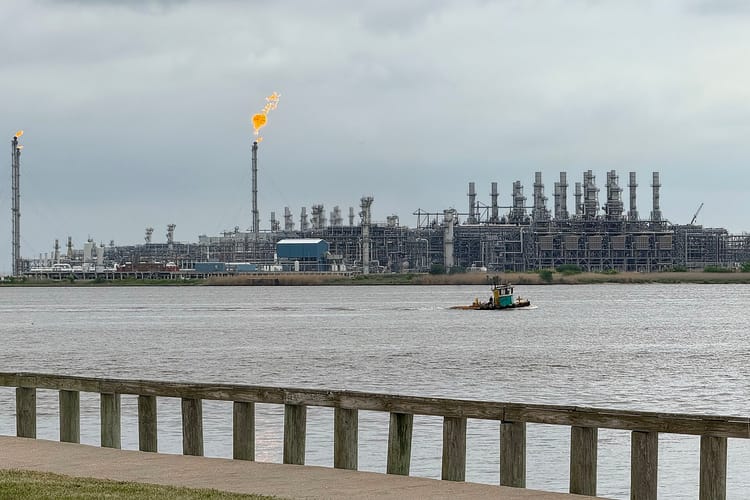
Meanwhile, in Cameron Parish, Venture Global has announced plans to expand its privately generated electricity infrastructure to support potential artificial intelligence data centers.
Its equipment agreements contemplate up to 16 additional power-generation units across company-controlled sites, with deployment depending on future commercial commitments.
Louisiana environmental records also identify an initial air-permit application by Cameron Generation, LLC, a company named within Venture Global's disclosed corporate subsidiary structure.
That project is not necessarily exposed to the same risks as the loans being auctioned on Wall Street.
Venture Global's proposed model involves privately generated electricity and a company with an established LNG business.
But that does not eliminate questions about financing, customer commitments, demand, or the consequences if a proposed computing facility never materializes.
The proposed facilities are different. The obligation to evaluate their financial assumptions should be the same.
A $10 Billion Announcement Is Not $10 Billion in the Bank
One of the most important things residents need to understand about economic development announcements is that projected investment is not the same as money already spent.
A company can announce plans for a multibillion-dollar project without having committed every dollar required to complete it.
Construction may be divided into phases.
Later phases may depend on market conditions, financing, customer demand, equipment availability, or regulatory approvals.
Some projects will proceed exactly as planned.
Others may be delayed, reduced in scope, sold, or abandoned.
None of that is inherently unusual in large-scale industrial development.
But it changes how communities should evaluate promises.
If a developer announces a $5 billion project that eventually results in $500 million of construction, the community has not necessarily received the development it was originally asked to support.
That difference becomes especially important when local governments have amended zoning, authorized infrastructure, or approved financial arrangements based on the larger proposal.
Before celebrating an investment announcement, officials should be able to identify which portions are contractually committed and which remain conditional.
If they cannot, residents should be asking why.
Who Pays If the Project Fails?
This is where the financial concerns become especially relevant.
Consider a hypothetical data center that requires a new electrical substation, major transmission improvements, road upgrades, and expanded water infrastructure.
Some of those improvements may be financed entirely by the developer.
Others may involve public utilities, government entities, financing agreements, or a combination of parties.
If the project is completed and generates the expected revenue, those arrangements may work as intended.
But what happens if the developer runs out of financing?
What happens if a major tenant cancels its agreement?
What happens if the facility operates at only a fraction of its anticipated capacity?
And what happens if the property is sold to another company that has not made the same commitments?
These are not merely theoretical concerns.
In February 2026, Reuters reported that Louisiana utility regulators had declined a request for further investigation into financial arrangements associated with Meta's Richland Parish development.
Earthjustice had questioned whether the arrangements sufficiently protected electricity customers if Meta discontinued service earlier than anticipated.
That does not establish that Meta intends to leave or that ratepayers will suffer losses. Meta and Entergy have emphasized contractual and financial protections, and Meta projects substantial customer savings.
But the dispute illustrates a legitimate question: Who ultimately bears the financial risk when infrastructure is built around a single exceptionally large customer?
That question should be answered before commitments are made, not after something goes wrong.
Louisiana Already Recognizes the Need for Financial Safeguards
Louisiana law provides certain sales and use tax exemptions to qualifying data center developments.
Under Louisiana Revised Statutes 47:305.73, approved projects generally must attest to plans for at least $200 million in capital investment and 50 new permanent jobs.
The statute also provides for agreements that allow the state to terminate exemption eligibility and assess taxes if specified statutory or contractual obligations are not fulfilled.
More recently, Louisiana Economic Development introduced a Ratepayer & Community Protection Framework intended to strengthen requirements involving electrical infrastructure, water resources, employment, and public accountability.
Those are important protections.
But they do not automatically answer every question about a particular project.
A tax exemption clawback, for example, is not the same as a financial guarantee covering abandoned construction or utility infrastructure.
A contractual obligation is only as useful as its terms, the resources available to enforce it, and the financial capacity of the parties responsible for fulfilling it.
Residents should ask which protections actually apply to the proposed development in their parish.
They should also ask whether the local government has negotiated protections of its own.
Seven Questions Every Louisiana Resident Should Ask Their Officials
The next time a police juror, mayor, or economic development representative describes a proposed data center as a good investment, ask them to explain the investment.
Not the headline figure.
The actual financial arrangement.
1. Who is financing the project?
Is the developer using its own capital, borrowed money, outside investors, or a combination? Have those funds been committed, or is the company still seeking financing?
2. Does the project have a committed customer?
If the developer plans to lease computing capacity, are there executed contracts with financially capable tenants? How long do those agreements last, and what happens if the customer leaves?
3. How much of the announced investment is guaranteed?
Separate the first funded construction phase from future phases that depend on additional financing or demand.
4. Who pays for infrastructure if the project is canceled?
Identify responsibility for roads, water systems, substations, transmission lines, and any other improvements required for the development.
5. What financial security protects the community?
Are there performance bonds, letters of credit, parent-company guarantees, escrow accounts, or other enforceable protections? How much do they cover, and when can they be used?
6. What happens if the property is sold or the developer declares bankruptcy?
Will contractual obligations transfer to a new owner? Can the government enforce those obligations if the original company no longer has sufficient assets?
7. Has anyone independently evaluated the financial risk?
Was the developer's financial capacity examined by an independent professional, or are officials relying primarily on the developer's projections and economic impact presentations?
These questions are not arguments against development.
They are basic due diligence.
And they should be answered with records, financial agreements, and documented commitments rather than assurances that a project will be good for the community.
Economic Development Is an Investment Decision, Even When the Parish Doesn't Write the Check
A police jury does not necessarily invest public money directly into a data center.
But local governments can make decisions that carry lasting economic consequences.
They can change land-use rules, approve development agreements, commit public infrastructure, authorize incentives within their legal authority, or make decisions that affect neighboring property owners.
Those choices have value.
And some are difficult to reverse.
A landowner who sells property to a developer receives an agreed purchase price.
A local government that changes the regulatory environment for an entire community is making a decision whose consequences extend well beyond a single transaction.
That decision deserves at least the level of scrutiny expected in an ordinary commercial investment.
If investors managing millions of dollars are questioning the financial durability of data center projects, local officials should be prepared to explain why their communities are adequately protected.
Not because every project will fail.
Because some inevitably will encounter delays, financing problems, or changes in demand.
Good planning accounts for that possibility.
Wall Street Is Asking Hard Questions. So Should Louisiana.
There is no established evidence that the $500 million loan sale involves any Louisiana data center project.
There is also no evidence from that transaction alone that the AI infrastructure industry is collapsing.
But the sale, the wider debt-market pressure, and growing investor concerns demonstrate that data center development carries risks serious enough to attract scrutiny from financial professionals.
Louisiana should not ignore those signals.
Our communities have every right to pursue new industries, attract employers, and benefit from private investment.
They also have every right to demand that the officials representing them understand the financial exposure behind the proposals they support.
A successful investment can create jobs, increase tax revenue, and improve local infrastructure.
A poorly structured agreement can leave a community with promises that never materialize and obligations that remain long after the developer has moved on.
The difference is determined, in part, by the questions asked before approval.
If your police juror tells you a data center is a good investment, ask whether they've reviewed the developer's financing, contractual commitments, and financial guarantees.
And if they haven't, ask what information they're using to reach that conclusion.
Because Wall Street doesn't accept an economic development presentation as proof that an investment is sound.
Neither should you.
Related reporting
If a Data Center Builds Its Own Power Grid, Who Pays When Things Go Wrong?
Sources and further reading
- Bloomberg, November 5, 2026: $500 Million Data Center Loan Auction
- Bloomberg, November 5: Hedge Funds Were Massive Sellers of AI Debt
- Bloomberg, October 28: Wall Street's AI Debt Machine Is Starting to Choke on Supply
- Louisiana Economic Development: Digital Factories
- Meta: Deepening Our Investment in Richland Parish
- Venture Global: October 2026 Power Expansion Announcement
- Louisiana Revised Statutes 47:305.73, Data Center Tax Exemptions
- Louisiana Economic Development: Ratepayer & Community Protection Framework
- Reuters, February 25: Louisiana Utility Regulator Rejects Request for Investigation Into Meta Agreement
Editorial disclosure: This article analyzes publicly reported financial developments, government records, corporate disclosures, and Louisiana economic development policy. It does not establish that any specific Louisiana data center developer is experiencing financial distress. Questions regarding hypothetical project failures and financial liability are presented as due-diligence considerations, not allegations of existing misconduct.



Member discussion
337.NEWS discussion
Join the conversation.
Sign up to comment on this story and follow the local reporting behind it.