Louisiana Is Open for Business. Just Don't Ask What Your Government Is Doing.
Louisiana has a secrecy problem.
And it seems to be getting considerably more expensive.
Since Governor Jeff Landry took office in January 2024, Louisiana has announced an extraordinary collection of industrial investments. Artificial intelligence data centers, rocket launch facilities, carbon sequestration projects, solar farms, and the massive infrastructure required to support them.
Billions upon billions of dollars.
The announcements are impressive. The promises are even better.
But there's another number that deserves just as much attention.
Fifty-four.
That's the minimum number of elected officials journalists identified as having signed nondisclosure agreements through Louisiana Economic Development since Landry took office.
And that doesn't include more than 120 employees of the governor's office who signed separate confidentiality agreements.
Previous reporting found that not a single elected official signed an NDA with Louisiana Economic Development during the final four years of Governor John Bel Edwards' administration.
Under Landry, officials representing every one of Louisiana's 64 parishes have signed them.
That's quite a change in how our government operates.
And the more closely we examine these development projects, the more difficult it becomes to dismiss the secrecy as an isolated administrative necessity.
SpaceX: The Most Expensive Example Yet
In August, Louisiana announced a proposed $100 billion SpaceX development in Vermilion Parish.
A rocket launch facility. Thousands of promised jobs. An entirely new industrial future for coastal Louisiana.
The governor called it historic.
But residents weren't invited to participate in most of the discussions that made it possible.
Public records show that dozens of state and local officials signed nondisclosure agreements around the negotiations.
And the documents reveal something extraordinary.
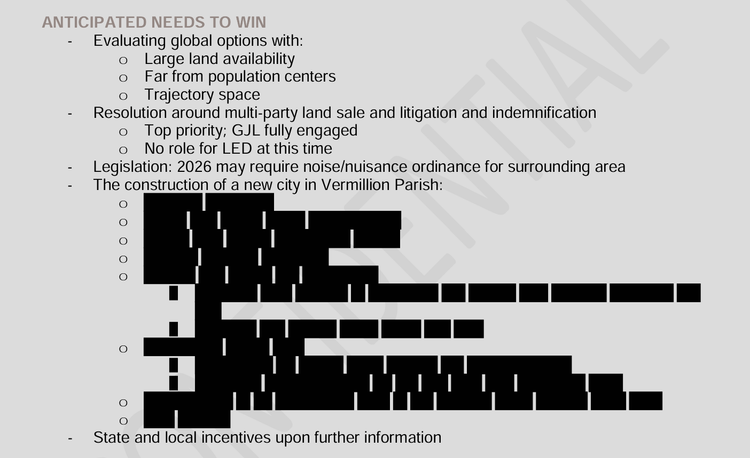
On March 12, months before the official announcement, Louisiana Economic Development prepared a confidential briefing under the name Project Osprey.
Among the things officials were considering was the construction of an entirely new city in Vermilion Parish.
Not just a rocket launch pad.
A city.
Other records reveal discussions involving highways, bridges, utility systems, coastal infrastructure, federal permitting, and coordination among government agencies.
The documents also contain extensive redactions, leaving important details of those discussions unknown.
On November 11, reporter Drew Hawkins published additional findings about the state's behind-the-scenes planning, including the proposed city and a coordinated approach to permitting.
We have also examined the redacted SpaceX planning records at 337.NEWS.
And then there's the money.
According to documents obtained by the Louisiana Illuminator, the state's incentive package was estimated at approximately $27.5 billion.
That figure includes projected tax incentives rather than an equivalent cash payment from the state treasury. But forgone tax revenue is still a public financial decision.
Louisiana's own economic development website also acknowledges that some road improvement costs may be shared between SpaceX and the state. It says the precise allocation remains under evaluation.
In other words, this was never simply a private corporation buying private land and conducting private business.
Land acquisition, tax policy, infrastructure, and regulatory coordination are involved.
Yet the public learned about much of the planning only after the negotiations were well underway.
What exactly is representative government supposed to represent in that arrangement?
The Data Centers Follow a Familiar Pattern
SpaceX isn't alone.
In Richland Parish, Meta's enormous Hyperion data center development was negotiated through confidential discussions involving corporate representatives, state officials, incentives, and electricity infrastructure.
In Northwest Louisiana, Amazon's $12 billion data center announcement followed negotiations in which the company's identity was concealed from residents.
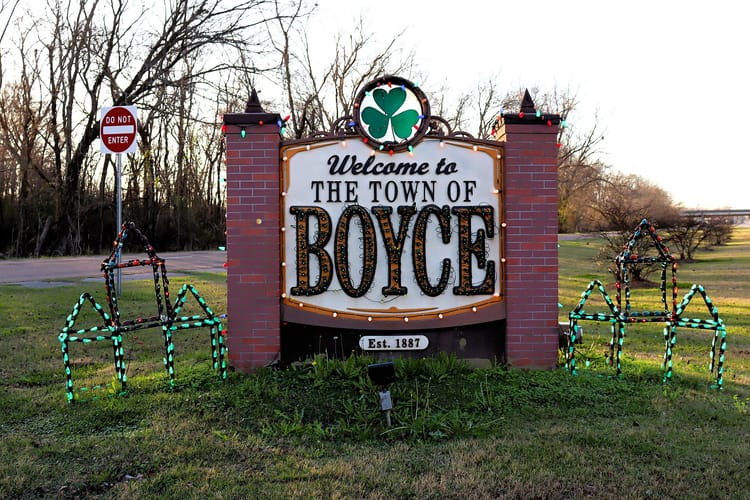
In Rapides Parish, Applied Digital's $3.6 billion Delta Forge 1 development near Boyce advanced while elected officials and members of the development board were bound by NDAs.
By the time Boyce residents received the state's formal announcement in May, site development had already begun.
Each development has different agreements and circumstances.
But the recurring issue is unmistakable.
The companies receive months of access to the people who control economic incentives, land transactions, and infrastructure planning.
Residents often receive the press release.
The state argues that secrecy helps secure competitive projects.
Fine.
Then explain where confidentiality ends and public accountability begins.
Because these aren't ordinary private investments when public taxing authorities, public infrastructure, and long-term utility commitments are involved.
A company can leave.
The electricity infrastructure, tax arrangements, and financial consequences can remain for decades.
Solar Farms: Thousands of Acres Before the Public Debate
Not every transparency problem involves a documented NDA.
Sometimes the problem is the development process itself.
In Vernon and Rapides parishes, residents confronted a proposed solar development spanning approximately 10,000 acres.
The project, being developed by Treaty Oak Clean Energy, included two large solar-array phases and a proposed nine-mile electrical interconnection.
In August 2026, the Vernon Parish Police Jury unanimously adopted a temporary moratorium on solar farm development in unincorporated areas.
Residents raised concerns about land use, environmental impacts, decommissioning, and the long-term consequences of such an enormous development.
Meanwhile, in Calcasieu Parish, the proposed Persimmon Energy Center north of Moss Bluff demonstrated how long a project can advance before entering the formal local permitting process.
Its developer reported beginning development in 2019 and obtaining land agreements years before submitting a parish project permit.
Those private negotiations are not inherently improper.
Landowners have the right to lease their property.
But an arrangement that begins as a private land transaction can eventually produce substantial public consequences.
Road access. Drainage. Transmission lines. Emergency response. Land-use regulation. Potential tax arrangements.
The public has an interest in those consequences.
And the first meaningful opportunity to comment should not arrive after a developer has spent seven years assembling the project.
To be clear, we have not established that either solar project involved a government NDA or taxpayer subsidy.
What they demonstrate is a related weakness: public review frequently begins long after private planning has created considerable momentum.
Carbon Capture: Public Land, Federal Money, and Decades of Obligations
Then there's carbon capture and sequestration.
Louisiana has become a major destination for companies proposing to inject carbon dioxide into deep underground geological formations.
The projects involve private property agreements, underground storage rights, pipelines, industrial facilities, and, in some cases, state-owned land and water bottoms.
The federal government provides substantial financial incentives for qualifying carbon capture operations.
Some projects have also received federal support for planning and feasibility studies.
Louisiana Economic Development identifies Cleco's proposed carbon-capture project near Lena in Rapides Parish as an example.
The state says a $9 million congressional appropriation, administered through LED, is helping fund a $12 million front-end engineering and design study.
The proposed project itself carries an estimated $900 million investment.
Again, that isn't automatically a bad investment.
But taxpayers have a legitimate interest in understanding what their money is supporting.
And the public interest becomes even stronger when state-owned underground storage rights or water bottoms are involved.
In May 2025, Louisiana's Mineral and Energy Board adopted guidelines for procuring carbon sequestration operating agreements on public land.
Those procedures are publicly documented.
But having a published procedure is not the same thing as providing early and meaningful public participation in every individual development.
The state has also held regulatory hearings on proposed carbon-storage wells across multiple parishes.
According to its own hearing guidance, these proceedings are designed to collect public comments, not necessarily provide a traditional town-hall exchange with residents.
And despite Governor Landry's October 2025 moratorium on certain carbon sequestration activities, projects qualifying for exceptions continued advancing in 2026.
The question isn't whether every carbon capture project should be stopped.
It's whether the public receives enough information, early enough, to evaluate the use of publicly owned resources, government incentives, environmental risks, and long-term responsibilities.
That becomes particularly important when the proposed storage operation could continue for decades.
We have not established that the carbon projects discussed here were secretly negotiated under the same NDAs used for data centers and SpaceX.
But the financing, public-resource, and regulatory issues belong in the same statewide accountability conversation.
And the Government Has Even Signed Agreements With Companies We Know Almost Nothing About
In August, reporting revealed that the Landry administration had also entered into confidentiality agreements involving Tesla and Oracle.
The exact purposes of those agreements weren't publicly established in the reporting.
That matters.
These aren't small, obscure businesses.
They're major corporations with interests in energy, technology, and infrastructure.
The existence of an agreement doesn't establish that a particular project is underway.
But it does raise a perfectly reasonable question.
What else is Louisiana negotiating that its residents haven't been told about?
We don't have to invent an answer.
We should expect our government to provide one when disclosure can occur without compromising legitimate commercial information.
This Isn't Just About Spending Money
Perhaps the most troubling part of these arrangements is how easily they blur several fundamentally different kinds of money.
A corporation announces a $10 billion investment.
The state advertises $10 billion in economic development.
But what does that number actually mean to the people living there?
How much is privately financed?
How much comes from federal grants?
How much is subsidized through state tax credits?
How much local property-tax revenue is being negotiated away or replaced through a Payment in Lieu of Taxes agreement?
How much new electrical infrastructure must be built?
Who pays if projected demand disappears?
And which public commitments survive if the company fails to deliver?
These aren't unreasonable questions.
They're the questions that should come before approving major public financial commitments.
The public should not need a team of investigative journalists, attorneys, and public-records researchers to reconstruct an economic development deal after the governor has already celebrated it.
Even the Governor's Own Office Has Embraced Confidentiality
The secrecy problem extends beyond individual developments.
In July, the Gulf States Newsroom and Type Investigations reported that more than 120 employees in Governor Landry's office had signed confidentiality agreements restricting disclosure of information obtained through their jobs.
Some of the agreements required employees to obtain the governor's written permission before disclosing information.
Legal experts questioned the breadth of those restrictions.
That doesn't prove the administration is concealing illegal conduct.
But it does help explain why transparency concerns have become impossible to separate from Louisiana's broader approach to economic development.
When confidentiality becomes an institutional expectation rather than a narrow exception, the public has reason to question whether secrecy is serving legitimate interests or simply making government more convenient for those already in power.
Here's the Part They Don't Want to Discuss
Economic development and public accountability are not competing interests.
They should reinforce each other.
A good deal should survive scrutiny.
A fair tax arrangement should survive scrutiny.
An infrastructure commitment that protects existing utility customers should survive scrutiny.
And a politician who claims to have negotiated a historic victory for Louisiana should welcome the opportunity to demonstrate exactly what Louisiana received in return.
Instead, we increasingly encounter a process where the public hears about the benefits first and must spend months uncovering the obligations.
That's backward.
And it creates a predictable advantage for corporations with the resources to negotiate directly with powerful officials while ordinary citizens remain outside the room.
We're not asking for confidential trade secrets.
We're asking about the public's land, tax revenue, infrastructure, regulatory decisions, and financial risk.
Those are public matters.
The People of Louisiana Deserve Better Than a Press Release
None of this means SpaceX should be rejected.
It doesn't mean data centers are inherently harmful.
It doesn't mean solar farms or carbon capture projects cannot benefit Louisiana.
And it doesn't mean every confidentiality agreement is unlawful.
It means something considerably simpler.
The government should not be able to use economic development as a blanket justification for withholding information about decisions that affect the public.
If an agreement requires confidentiality, establish clear limits and meaningful disclosure deadlines.
If tax incentives are offered, publish their estimated value and conditions.
If public infrastructure is required, identify the expected cost and who will pay.
If public land or underground storage rights are involved, explain the terms.
If residents must live with the consequences for decades, give them a meaningful opportunity to participate before the outcome becomes practically irreversible.
And if a corporation refuses to proceed without keeping the public completely in the dark, perhaps our elected officials should ask whether that is a corporation Louisiana ought to be negotiating with.
Since January 2024, we've seen enough examples to know this isn't one isolated project.
It's a governing philosophy that increasingly treats confidentiality as the price of progress.
But secrecy is not economic development.
An NDA is not public accountability.
And a press conference is not public participation.
Louisiana may be open for business.
It's time we demanded a government that's open to the people paying for it.
Sources and documentation
- Gulf States Newsroom / Type Investigations: NDAs and Louisiana economic development
- Type Investigations: More than 120 governor's office employees signed NDAs
- Drew Hawkins, November 11, 2026: Secret planning for a new SpaceX city
- Louisiana Illuminator: Estimated $27.5 billion SpaceX incentive package
- Louisiana Economic Development: SpaceX incentive, infrastructure and permitting details
- NPR: NDAs and Louisiana data center negotiations
- Vernon Parish: Solar moratorium and Treaty Oak project
- KPLC: Persimmon Energy Center land negotiations
- Louisiana Economic Development: Cleco carbon capture project and public appropriation
- Louisiana Department of Conservation and Energy: Carbon sequestration permits
- Louisiana Department of Conservation and Energy: Public-land carbon sequestration guidelines
- Louisiana Illuminator: Carbon sequestration continuing during Landry moratorium
- 337.NEWS: Louisiana Public Records Repository
- The Times-Picayune / The Advocate: Louisiana signed NDAs with Tesla, Oracle
337.NEWS | Editorial | November 11, 2026
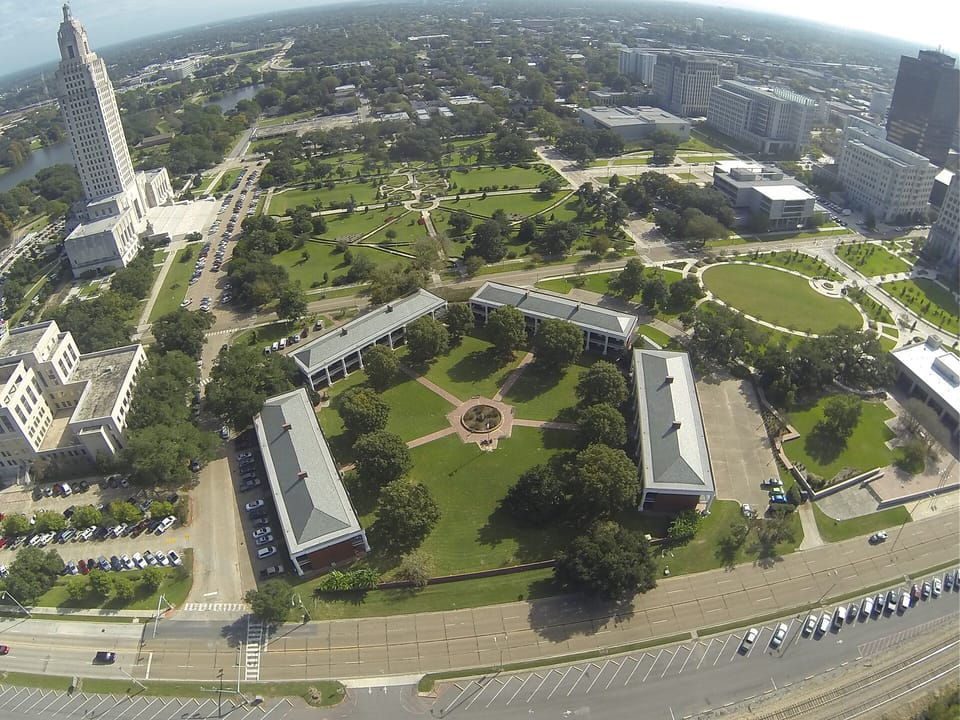
Photo: Aerial view of the Louisiana State Capitol grounds and Pentagon Barracks, Baton Rouge. Photo by Louisiana Sea Grant, CC BY 2.0, via Wikimedia Commons.

Member discussion
337.NEWS discussion
Join the conversation.
Sign up to comment on this story and follow the local reporting behind it.