Inside Project Osprey: 38 Pages of Redactions, Secret Meetings and Louisiana's SpaceX Negotiations
I’ve been reading a 38-page collection of Louisiana government records about SpaceX’s proposed Vermilion Parish development. Some of it reads like an ordinary government email chain. Some of it looks like somebody took a black marker to nearly everything that mattered.
There are so many redactions that the Epstein files come to mind. That’s a comparison about how the pages look, not a claim that we’ve counted and compared redactions in the two releases.
But the parts Louisiana left visible are more important than the black bars.
Months before the public announcement, state officials were discussing a new city, special legislation, rocket manufacturing, complicated land negotiations and a coordinated approach to federal permitting. The confidential project went by the name Project Osprey.
This is not speculation based on an anonymous social media account. The details appear in Louisiana Economic Development (LED) briefings, agency emails and a U.S. Army Corps of Engineers meeting agenda in the 38-page CPRA records release.
The documents establish that these matters were under discussion. They do not establish that every proposal was approved, that every law was changed at SpaceX’s request, or that an independent regulator waived its obligations.
March 12: A city, rocket manufacturing and a land problem
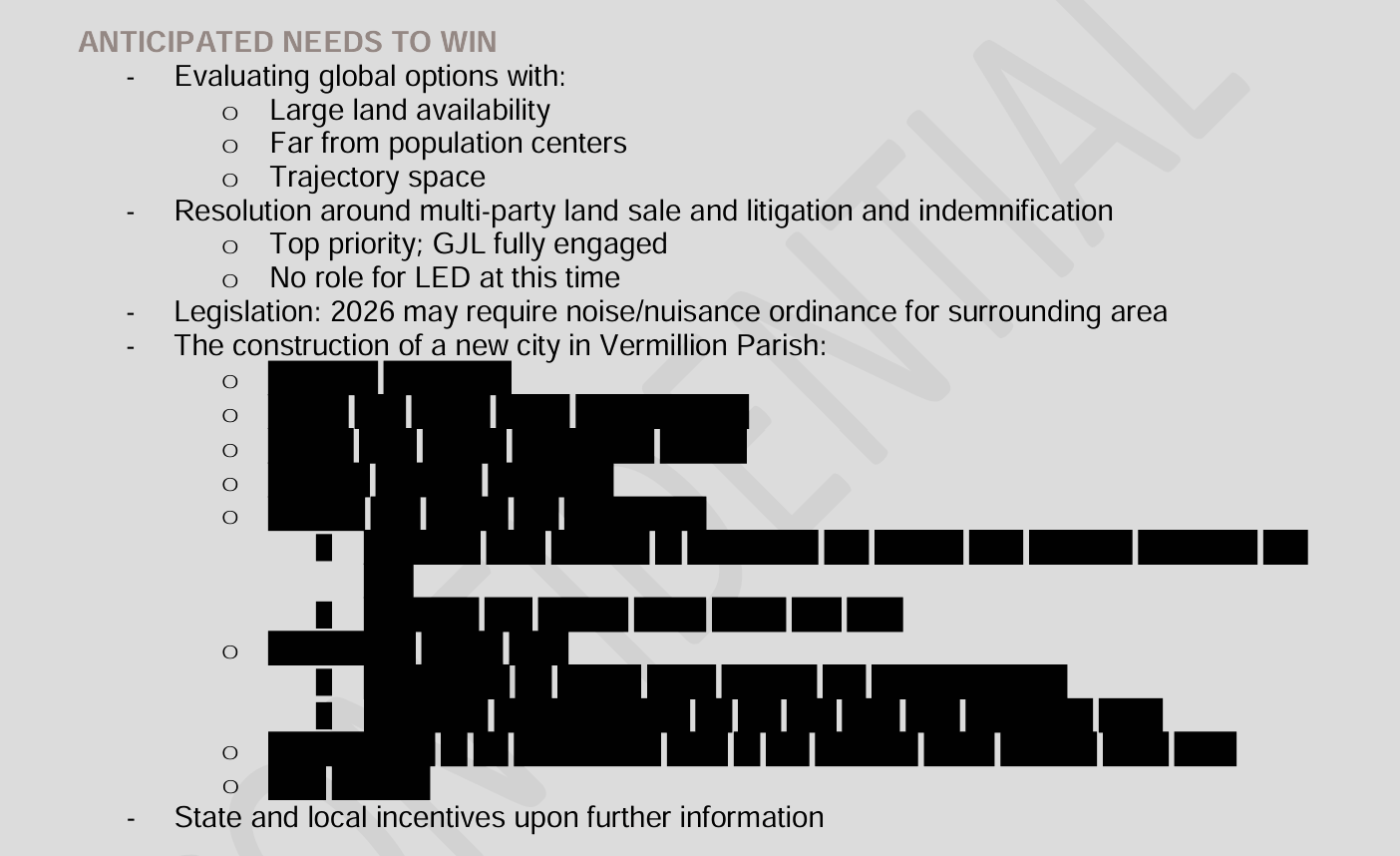
The first major document is on page 6, marked Project Osprey Briefing and Highly Confidential – Attorney Client Privilege.
It identifies two separate projects: development of what the state calls the world’s largest launch site and manufacturing of launch vehicles. That matters now that SpaceX job postings referring to Louisiana Starship production are attracting attention. Manufacturing wasn’t a concept that surfaced for the first time in November. It was part of the confidential project discussion in March.
The briefing identifies land owned by ExxonMobil and describes a 100-year, non-terminable hunting lease held by the Vermilion Duck Hunting Club. It says a sale would require three-party negotiations and that “GJL” had offered to lead support efforts. The document does not spell out those initials; readers should not treat an interpretation of them as a fact established by the briefing.
Under a heading labeled Anticipated Needs to Win, the state lists resolution of land-sale, litigation and indemnification issues, possible 2026 noise/nuisance legislation, and “The construction of a new city in Vermillion Parish.” Several lines underneath the proposed-city heading are blacked out.
That last item is extraordinary. A city isn’t a warehouse or a rocket launchpad. It is a governmental entity, with public powers and public obligations. The file shows it was considered; it does not show an incorporation petition, a final municipality plan, or a decision to proceed.
Also on page 6, the project rationale mentions orbital data centers, testing and deployment, NASA’s lunar plans, and a third gateway alongside Texas and Florida. Importantly, orbital data centers are not evidence that SpaceX had decided to build a conventional ground-based data center in Vermilion Parish.
Source: CPRA release, pp. 4–6.
March 13: Louisiana studied the Texas Starbase model
On page 8, LED official Paige Carter circulated a presentation about the existing Starbase development in Texas. The presentation itself appears on pages 11–21.
It isn’t merely a slideshow about rockets and economic development. Page 12 discusses the Texas city’s population and company-owned land. Page 15 discusses Texas rules that allow launch-related road and beach closures and the difference between municipal and county control. Pages 16–17 outline incentives. Pages 19–21 examine development in wetlands and compare satellite views over time.
Taken together with the March 12 reference to constructing a new Louisiana city, the slides raise an obvious question: Was Louisiana evaluating a company-centered municipality partly for the same public-access powers SpaceX obtained in Texas?
That is an investigative question, not an established conclusion. The presentation proves officials studied those features; it does not disclose a final policy recommendation.
Source: CPRA release, pp. 8, 11–21.
April 6: The company was shaping infrastructure evaluations
An April 6 email on page 22 says Carter had company approval to share material with transportation and coastal officials for evaluation. The visible language refers to highway and marine access, shoreline work and bridges, along with updated anticipated property boundaries.
Much of the actual technical material is missing or redacted in this release. Without those attachments, we cannot quantify what the company requested at that stage or determine what costs state agencies were expected to assume.
Still, this establishes that infrastructure assessments were underway well before the public announcement.
Source: CPRA release, p. 22.
April 22: An extensive legislative package, $20 billion first phase, and more black bars
The April briefing, on page 34, is one of the most consequential pages in the entire packet.
It calls the launch facility phase one, with a minimum projected capital investment of $20 billion, a figure the briefing says would likely reach $50 billion, and at least 3,000 jobs. It describes launch-vehicle manufacturing as phase two, dependent on the launch-site investment. Those are internal planning estimates and phase assumptions, not proof that the money was spent or the jobs were created.
Then comes a list of anticipated requirements to win the project:
- Extensive land acquisition and litigation matters.
- “Multi-bill legislative package”, coordinated with the governor’s office.
- Extensive requirements for DOTD, the U.S. Army Corps of Engineers and power infrastructure.
- Additional CPRA requirements, largely hidden by redactions.
The most specific demands are precisely what the public cannot read. The document does not identify the bills or prove who wrote their language. It does make clear that state officials were discussing an extensive legislative effort in connection with Project Osprey.
The email distributing this briefing, on page 33, told participants not to use the company’s name and to treat the materials with strict confidentiality. This is evidence of a coordinated confidentiality practice. It is not, on its own, proof that every person on the email signed a nondisclosure agreement.
Source: CPRA release, pp. 33–34.
July 9: Federal regulators and state officials planned a joint permitting strategy
On pages 35–38, the record shifts from internal briefings to coordination with the U.S. Army Corps of Engineers.
The invitation and meeting agenda list senior Corps officials, LED leadership, transportation and coastal officials, utility executives, Royal Engineering, One Acadiana and other participants. The agenda describes an effort to align agencies on permit requirements, timelines and responsibility for decisions.
The stated objectives include identifying Corps authorizations, Section 408 issues, a coordinated review process, and evaluating a possible Section 214 agreement. Section 214 arrangements can provide a framework for applicants to fund additional agency review capacity, subject to legal safeguards. The agenda shows this option was on the table; it does not establish that an agreement was signed or that the Corps surrendered independent regulatory authority.
One detail is especially relevant in light of recent reporting on Louisiana’s up-to-$6.8 million transportation engineering contract: Royal Engineering’s CEO is listed as a participant in the July 9 meeting, months before that contract became public. Participation alone does not demonstrate an improper award. It does justify scrutiny of the procurement timeline, scopes of work and previous project involvement.
By July 28–31, officials were coordinating an additional August 4 meeting with the company and agency representatives. Some of the company-submitted materials and identities remain obscured in this release.
Source: CPRA release, pp. 1–3, 35–38.
What is hidden, and what we cannot conclude
The redactions aren’t a minor footnote. On page 6, the detailed bullets under the new-city proposal disappear. On page 34, much of the agency-specific legislation, infrastructure and power discussion is concealed. Several intervening pages render with essentially no readable substantive information. Page 3 contains a largely blacked-out external message.
The repeated Attorney Client Privilege marking is visible, but a stamp is not a substitute for a page-by-page legal explanation of each withholding. We have not established whether every redaction is justified or which Louisiana public-records exemptions were invoked. The release also does not provide a complete inventory of withheld attachments.
And there are basic things the records do not prove:
- That a new Louisiana city has been authorized or incorporated.
- That SpaceX demanded, drafted or secured every piece of legislation mentioned internally.
- That any individual official acted unlawfully.
- That a Section 214 agreement was finalized or federal permits were guaranteed.
- That the company has completed its promised investment or created its projected jobs.
Those limits matter. An investigation loses credibility when it fills a black bar with whatever the writer suspects is underneath it.
The public question isn’t whether Louisiana should welcome SpaceX
People can support rocket manufacturing, jobs and investment while still asking what government officials were negotiating on their behalf.
In March, state officials discussed creating a municipality and altering the legal landscape. By April, they were discussing a multi-bill legislative package and extensive transportation, federal permitting and power requirements. By July, agencies and utilities were assembling a coordinated permitting approach. All of that preceded the public unveiling of the project.
The question is not whether economic development requires confidential conversations. It is when those conversations turn into proposed public powers, public expenditures, public-road decisions or changes to the law, and what the people affected are entitled to know.
Louisiana residents deserve the unredacted legal authority for the withheld passages, the proposed legislative package, the relevant procurement and infrastructure records, and a clear accounting of what was proposed versus what was agreed.
It’s difficult to evaluate a deal when the most interesting sentences are hidden behind black rectangles.
Documents and related reporting
- Primary document: CPRA Records 1, 38-page public-records release, DocumentCloud. Page numbers cited above refer to this PDF.
- Original reporting credit: Drew Hawkins, Gulf States Newsroom / WWNO, on the proposed SpaceX municipality. Hawkins previously reported the new-city finding from the confidential records. This article separately examines the release and its broader chronology.
- 337.NEWS public-records archive: Louisiana Public Records Repository. This is a related research resource, not a claim that this particular release is hosted there.
Reporting note: This analysis is based on the 38-page CPRA release. The publicly released PDF is extensively redacted. Absence of a fact from that release does not demonstrate that the fact never existed. Claims about laws enacted, permit approvals or contracts executed require comparison against those separate primary records.
Related reporting
Louisiana officials considered a new city for SpaceX; job postings now point to Starship production

Member discussion
337.NEWS discussion
Join the conversation.
Sign up to comment on this story and follow the local reporting behind it.