Louisiana Wanted $65.50 for Public Records It Could Send by Email

I requested 31 nondisclosure agreements connected to SpaceX's Project Osprey. The state identified 262 pages, offered to email them after payment, or let me inspect them in person for free.
On October 8, I submitted a public records request to Louisiana Economic Development (LED).
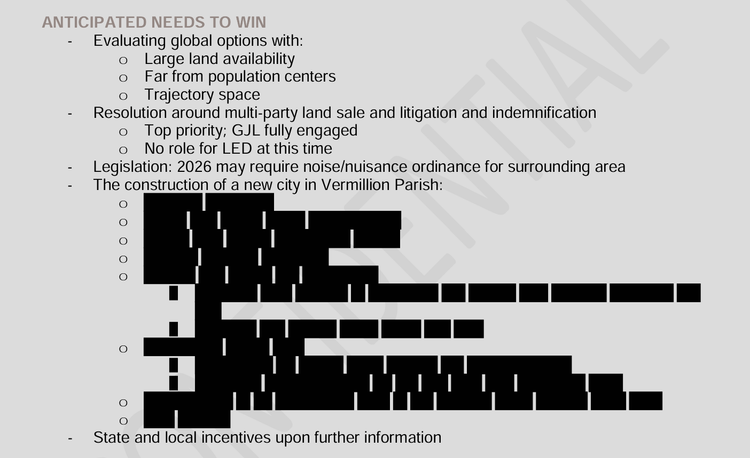
I wanted to know who had signed nondisclosure agreements surrounding Project Osprey, the code name associated with SpaceX's proposed Louisiana spaceport development.
The Times-Picayune | The Advocate had already reported on these agreements. I wasn't asking the state to investigate anything new, prepare a report, or explain its decisions.
I requested copies of 31 previously disclosed agreements, including their signature pages, so I could independently examine who signed them, what organizations they represented, and when they signed.
Twenty-two days later, I received an answer.
The records were available.
There were 262 pages.
And it would cost me $65.50 to receive them by email.
Public records, private expense
On October 19, LED acknowledged my request and estimated that the records might not be available until December 31, 2026.
The agency explained that collection, segregation, redaction, examination, or review could be necessary.
On October 30, LED notified me that the records were ready, well ahead of its original estimate.
The agency wrote:
"Documents responsive to your public records request are now available. The documents total 262 pages."
LED assessed a fee of $65.50, calculated at 25 cents per page.
Once payment was received, the agency said it could email the documents to me.
Alternatively, I could inspect the records at its office at no charge and pay for individual pages I wanted copied.
There was no explanation in that response of whether the documents already existed electronically, whether physical copies would be produced, or why an electronically delivered packet required a per-page charge equivalent to paper copying.
And that raises a question.
If a government agency already has records available for electronic delivery, what exactly is the public paying for?
The law allows fees. That doesn't end the discussion.
Louisiana Revised Statute 44:32 authorizes state agencies to charge applicable fees for copies of public records.
The Louisiana Legislative Auditor explains that the state's standard schedule allows a 25-cent-per-page charge for ordinary paper copies.
The law also permits public records to be inspected without charge during regular office hours.
So the existence of a fee, standing alone, does not establish that LED violated Louisiana law.
But Louisiana law also allows state agencies to provide records without charge or at a reduced rate when the custodian determines that their use will be limited to a public purpose.
Independent reporting on government agreements and the actions of public officials presents an obvious reason to ask whether that discretion should be exercised.
LED's October 30 response did not offer a fee reduction, identify an electronic-copy pricing alternative, or explain whether one was available.
I have not established whether the agency considered any of those alternatives internally.
Access shouldn't depend on where you live
Louisiana's public records law gives people a right to inspect government records without paying a copying fee.
But an in-person inspection opportunity is not equally practical for everyone.
If you live near the agency's office, perhaps you can visit during business hours.
If you live several parishes away, an inspection may require transportation, time away from work, and additional expenses that could exceed the price of the documents themselves.
And if you want to search the records, compare signatures, preserve documents for future reporting, or provide copies to the public, simply viewing them at an office may not accomplish your purpose.
The agency has offered an avenue for access.
That doesn't necessarily mean the avenue is accessible on equal terms.
The distinction matters.
Why these particular records matter
Project Osprey is not an ordinary private business negotiation.
It involves a major proposed industrial development, government officials, public institutions, land-use decisions, and substantial economic interests.
Previous reporting has identified nondisclosure agreements signed by officials and others involved in the project.
Some of these agreements concern public officials who may also have responsibilities to represent residents, participate in public decisions, or oversee regulatory matters.
A nondisclosure agreement does not, by itself, prove wrongdoing.
Nor does signing one necessarily mean an official has concealed information unlawfully.
But understanding who signed such agreements, in what capacity, and when can help the public evaluate how information moved through government before decisions became public.
That is why I sought the actual agreements rather than relying exclusively on another newsroom's interpretation of them.
Independent verification requires access to the underlying records.
And when the public must pay to independently verify documents that have already been produced for another requester, the cost can discourage further scrutiny, even when the fee complies with the law.
A barrier does not require proof of bad intentions
I cannot establish that Louisiana Economic Development deliberately structured its response to discourage scrutiny.
The correspondence does not establish that.
LED responded, located the records, and made them available earlier than originally anticipated.
Those facts deserve acknowledgment.
But I also cannot ignore the practical outcome.
I asked for government records to independently identify the people involved in confidentiality agreements surrounding a major public-interest project.
The agency identified nearly 300 pages and conditioned electronic delivery on a $65.50 payment.
My other option was to inspect the documents in person.
Whether or not anyone intended to discourage access, the process introduced a financial or logistical barrier between a member of the public and records held by the government.
A barrier doesn't have to be intentional to have an effect.
What happens next
The correspondence leaves several questions unanswered.
Were these 262 pages already maintained in electronic form? How does LED determine the charge for sending existing electronic records? Is the agency willing to provide only the relevant signature pages at a reduced cost? And will it consider the statutory provision allowing reduced or waived fees for public-purpose uses?
I intend to seek clarification before treating the fee as a final obstacle.
For now, the documents have not been independently reviewed by 337.NEWS, and I cannot confirm the identities or contents of all 31 agreements from LED's unreleased packet.
What I can document is the process.
A request made October 8.
Records identified October 30.
262 pages.
$65.50.
Electronic delivery available after payment.
Free inspection offered in person.
The public's right to know is meaningful only when ordinary people can realistically exercise it.
And that is worth examining independently of whether the agency followed its fee schedule.
Related reporting
337.NEWS Opens Louisiana Public Records Archive to the Public
Project Osprey: What Happened Before Starbase Louisiana Was Announced
Disclosure and reporting methodology
This article is based on original correspondence between Dalton Barron of 337.NEWS and Louisiana Economic Development dated October 8, October 19, and October 30, 2026.
The request concerned 31 Project Osprey nondisclosure agreements reportedly released in an earlier public records production. The original request sought the agreements and signature pages, not the creation of a new list.
As of publication, 337.NEWS has received LED's fee notice but has not obtained the 262-page production. No conclusion is made that LED intentionally obstructed access or violated public records law.
Legal references: Louisiana Revised Statutes 44:1 and 44:32; Louisiana Administrative Code, Title 4, Part I, Section 301.
337.NEWS is independently published. Dalton Barron is also a licensed Louisiana real estate agent affiliated with NextHome Bayou Pines in DeRidder. This reporting is independent of his brokerage and does not represent the position of NextHome Bayou Pines, its broker, or its agents.



Member discussion
337.NEWS discussion
Join the conversation.
Sign up to comment on this story and follow the local reporting behind it.