SpaceX Brought Billions to Brownsville. How Much Reached the People Who Already Lived There?

SpaceX Brought Billions to Brownsville. How Much Reached the People Who Already Lived There?
SpaceX says its operations generated more than $13 billion in economic activity around Brownsville, Texas. The company also reports more than 24,000 direct and indirect jobs supported, about $305 million in indirect tax revenue, and $147 million in local supply-chain spending.
For Louisiana, as it prepares for a possible SpaceX development in Vermilion Parish, the sharper question is different: how much of that money improved the finances of people who lived there before the company arrived?
For the Louisiana land and public-property context, see our Starbase land-rush report and the public-property lease explainer.
A company can spend billions, fill hotels, push up housing demand, and still leave many original households no better off. Brownsville shows both sides of that: real local hiring, and real gaps in what the public numbers prove.
What the $13 billion does not show
In October 2025, Cameron County officials released an economic impact report prepared by SpaceX. It projected more than $13 billion in gross regional economic output over 2024–2026. This is a projection, not a measured household-income gain.
Economic output is not household income. A contract to an outside firm, equipment bought out of state, wages paid to workers who live elsewhere, and money passing through several businesses all count as activity. So do indirect supply-chain effects and induced spending as money circulates.
The summary does not break out how much became local wages, local business profits, public revenue, or durable investment for households that were there before Starbase. Without that breakdown, you cannot turn $13 billion into a dollar figure for original residents.
Local hiring, with a gap
Brownsville does not support a blanket claim that SpaceX relied mainly on outsiders. Company figures put 71% of Starbase employees as Cameron County residents as of 2020. In a 2025 Texas economic-incentive proceeding, a SpaceX representative reported that nearly all 500 employees hired for the GigaBay project between April and mid-September were Cameron County residents. The company also reported about 4,300 direct Starbase employees by late 2025.
But residence at the time of reporting is not the same as residence before Starbase. A worker counted as local could be a lifelong resident, someone who moved there years earlier, or someone who moved specifically for the job. Only the first group answers whether original residents got new jobs.
That does not make the hiring claims false. It limits what they prove.
Income went up, but who got it?
The Census Bureau's Small Area Income and Poverty Estimates put Cameron County median household income at $52,973 in 2024. A comparable 2019 figure needs confirmation before stating a growth rate.
A countywide median also moves when higher-income households move in, lower-income households move out, or the population changes, and for reasons unrelated to one employer. So it cannot say how much went to families who were there before the expansion.
The Census Bureau's 2020-2024 American Community Survey still put Cameron County median household income at about $52,600, roughly one-third below the Texas median, with a poverty rate around one-quarter of the population. Growth and persistent hardship existed at the same time.
Housing rose faster
The Texas Real Estate Research Center at Texas A&M University charts rising Cameron County property values and homeowner tax bills from 2019 to 2025. The center's public article presents the trend in charts; the precise chart values have not been independently checked for this report.
That does not prove SpaceX caused the whole increase. New construction, other employers, inflation, and wider market conditions also mattered, and the income figures end in 2024 while the housing figures run to 2025.
The effect still splits by tenure. An existing owner who sells can gain. An owner who stays gets no spendable income from appreciation and may face higher tax pressure, though Texas homestead exemptions and appraisal caps provide some protection. A renter gets no equity gain. A first-time buyer faces a higher barrier to ownership.
Temporary workers are the Louisiana question
Large builds need large construction crews before permanent operations start. Our reporting on industrial growth and housing in Southwest Louisiana examines the local stakes. Those workers stay in hotels, short-term rentals, RV parks, leased houses, or company-arranged housing. Hotels, restaurants, and landlords who house them benefit.
But the benefit depends on who gets paid and how long demand lasts. If 2,000 temporary workers need housing for two years, landlords may raise prices in response. Some residents earn rent. Others have a harder time finding affordable housing. When demand falls, the rental market is left changed.
This is a risk to investigate, not proof it explains Brownsville's whole price rise. The Starbase summaries do not break out temporary workers by prior residence, housing arrangement, or local spending, so the net effect on original residents cannot be calculated from them.
Local spending can leak
The reported $147 million in local supply-chain spending shows SpaceX bought through regional businesses. But a locally headquartered contractor employing residents keeps more of that money locally than a regional branch of a national contractor using imported workers, outside subcontractors, or materials sourced elsewhere. Both can be counted as regional spending.
To judge it, the public would need to know how many contracts went to businesses already operating locally, how much labor was done by existing residents, and how much spending left the region. The summary does not give that level of detail.
Who benefited, in short
Existing residents hired by SpaceX gained directly if wages, benefits, or career prospects improved. Existing business owners could gain from more demand. Existing property owners could gain from appreciation, rent, or a sale, offset by taxes and carrying costs. Existing renters could gain from jobs but get no equity and may face higher rent. Residents outside the SpaceX economy could face higher costs with no income gain.
We do not know how many households fall in each group, or the net result for them.
What Louisiana should ask
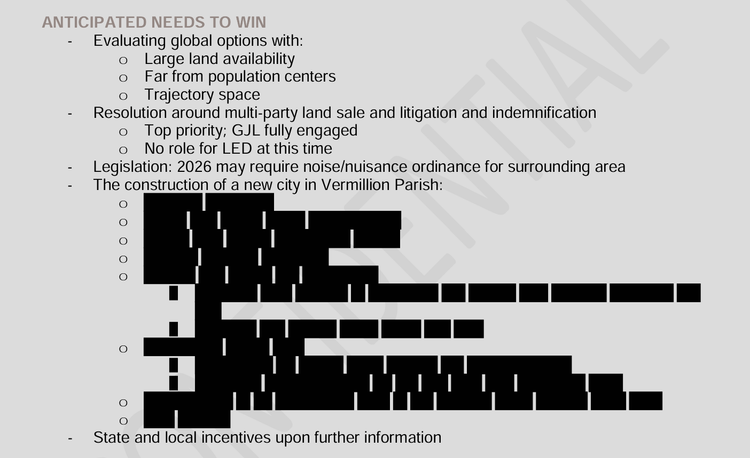
Louisiana Economic Development describes a planned $100 billion SpaceX campus in Vermilion Parish and says the project is expected to create 3,000 direct jobs over ten years. The state announcement does not establish that those targets have been met. The public records archive currently indexes related federal information requests. This report does not claim to have verified precise contractual milestones from the executed Project Osprey agreement.
Brownsville suggests Louisiana should require independent reporting on:
- How many permanent jobs go to people who lived in the surrounding parishes before construction began?
- How many construction jobs go to existing residents rather than temporary workers from elsewhere?
- Do wages for local workers rise faster than housing costs?
- How much project spending goes to businesses already operating in the region?
- What happens to housing costs for local renters and homeowners?
- What extra costs do local governments face for roads, utilities, public safety, and other infrastructure? Without those measures, Louisiana could report billions in economic activity and still not answer whether ordinary residents became more financially secure.
The evidence shows SpaceX created local jobs, business activity, and a growing regional economy, including nearly all hires in one documented 2025 expansion group. Those gains should not be dismissed.
But the public figures do not give a reliable dollar amount for extra income kept by people who lived in Brownsville before SpaceX arrived, or how those gains compare with housing costs, property taxes, and other pressures.
A community can get economically larger without every household that was already there getting economically better off. When a company announces billions, the public deserves to know who received it, who kept it, and whether the people who were already there are better off.
Sources and public records
- City of Brownsville, SpaceX Economic Impact Announcement
- Cameron County, 2024 SpaceX Economic Impact Release
- SpaceX Economic Impact Assessment, Earlier Workforce and Income Figures
- The Texas Tribune, January 29, 2026
- Texas A&M Real Estate Research Center, July 30, 2026
- Federal Reserve Economic Data, Cameron County Median Household Income
- U.S. Census Bureau, Cameron County QuickFacts
Reporting Note
The economic impact figures discussed here originate primarily from SpaceX disclosures distributed by local officials. They do not independently establish household-level financial gains. The reported local workforce percentages reflect residence at the time measured, not proof of residence before SpaceX's arrival. Housing-price changes cannot be attributed solely to SpaceX without additional analysis.
Author Disclosure
The author of 337.NEWS is also a licensed Louisiana real estate agent affiliated with NextHome Bayou Pines. All reporting, opinions, and editorial content are produced independently and do not necessarily reflect the views, positions, or opinions of NextHome Bayou Pines, its broker, or its affiliated agents.


Member discussion
337.NEWS discussion
Join the conversation.
Sign up to comment on this story and follow the local reporting behind it.